Showing posts with label Fun Internet Games. Show all posts

Thursday, August 25, 2016

Radiation-pressure propulsion for nano-spacecraft

Abstract: The Breakthrough Starshot project proposes using radiation-pressure propulsion to send multiple spacecraft in the gram-range mass to interstellar targets. There are numerous engineering challenges to accomplishing this mission, but their project discusses speeds and accelerations previously only discussed for cannon projectiles and particle physics experiments. This article examines the problem from first principles to see if the project is even orders-of-magnitude possible. A preliminary check on their numbers seems to confirm that the project is possible in principle.
 Radiation pressure has been hypothesized since the early days of special relativity and quantum mechanics. It is a simple consequence of the mass-energy equivalence and the photon nature of light. Quantum mechanics states that light is made of photons, and that each photon is a discrete bundle of energy. The energy \(E_{pho}\) carried by each photon is proportional to its frequency \(\nu=c/\lambda\), and the proportionality constant is Planck's constant \(h\).

\[E_{pho}=h\nu=\frac{hc}{\lambda}\]

Everyone knows the famous mass-energy equivalence equation \(E=mc^2\). However, that is only a special case of the momentum equation:

\[E=\sqrt{p^2c^2+m_0^2c^4}\]

We can solve this for the momentum of a photon, considering that its rest mass is zero.

\[\begin{eqnarray}E_{pho} & = & \sqrt{p_{pho}^2c^2+0^2c^4}\\
& = & \sqrt{p_{pho}^2c^2} \\
& = & pc\\
\frac{hc}{\lambda}&=&p_{pho}c\\
\frac{h}{\lambda}&=&p_{pho}\end{eqnarray}\]

Note that momentum is a vector quantity, but this just deals with the magnitude. The direction of the momentum vector is the direction the photon is traveling.

Now, we know the energy and momentum of each photon, so we know that if we throw so many joules of photons at a target, it will transfer so much momentum. The irradiance is defined as the power \(P\) (energy \(E\) per unit time \(t\)) of the light hitting each unit area of the target, so the units are W/m^2 or J s^-1 m^-2. We can calculate it from the amount of energy striking the target of known area \(A\) per unit time:

\[I=\frac{P}{A}=\frac{E}{tA}\]

So given a certain amount of irradiance with a known photon wavelength, how much momentum does that light carry? First, figure out how many photons per time per area \(I_{pho}\) that irradiance represents:

\[\begin{eqnarray}I_{pho}&=&\frac{I}{E_{pho}}\\
&=& \frac{I\lambda}{hc}\end{eqnarray}\]

The dimension of photon irradiance is photons per time unit per area unit (photon s^-1 m^-2 in SI units).

Now a bit about momentum. Again, everyone knows Newton's second law \(\vec{F}=m\vec{a}\), but again this is a special case. Force is defined as the change in momentum per unit time:

\[\vec{F}=\frac{d\vec{p}}{dt}\]

For massive objects at sub-relativistic speeds, momentum is defined as the mass of the object times the velocity of the object. For relativistic conditions, we use the energy relation above, where energy still has the customary units J=kg m^2 s^-2. Working through the units of the energy equation in the special case of a photon, we find that momentum still has the same units as it does in sub-relativistic conditions.

So from this, a given amount of energy of photons carries a certain amount of momentum. A certain power of photons carries a flow of momentum per unit time, or in other words Force. A certain amount of momentum flow impinging on a certain area is the same as a force exerted on that area, or a Pressure \(\rho\). So, we can calculate the pressure exerted by a given irradiance of light from the intensity in photons/time/area, multiplied by the momentum of each photon, which gives momentum/time/area which equals force/area which equals pressure:

\[\begin{eqnarray}\rho&=&I_{pho}p_{pho}\\
&=&\left(\frac{I\lambda}{hc}\right)\left(\frac{h}{\lambda}\right)\\
&=&\frac{I}{c}
\end{eqnarray}\]

So the pressure exerted by the light is the irradiance of the light divided by the speed of light. That is amazingly simple, and notice that both Planck's constant and the wavelength cancel out. Now we can start plugging numbers.

First, let's do one of Clarke's space yachts. It weighs on the order of 1000kg and has on the order of 1km^2=1,000,000m^2 of sail, and it uses natural sunlight. How much force does it collect and what is its acceleration? Note that since the sails are reflective, the light is reversed in direction and has a momentum change of twice its original momentum, so we collect twice as much force as the momentum suggests.

\[\begin{eqnarray}I& & &\approx&1400\mbox{W/m}^2\\
c& & &=&299,792,458\mbox{m/s}\approx 3\times 10^8 \mbox{m/s}\\
\rho&=&2\frac{I}{c}&=&2\frac{1400}{3\times 10^8}=9.4\mu \mbox{N/m}^2\\
A& & &=&1,000,000 \mbox{m}^2\\
F&=&P_{pho}A&=&9.4\mbox{N}\\
m& & &=&1000 \mbox{kg}\\
a&=&\frac{F}{m}&=&\frac{9.4}{1000}=9.4\mbox{mm/s}^2\approx1.0\mbox{mg}
\end{eqnarray}\]

So the whole sail exerts a measly couple of newtons. Pulling on a ton of mass, we get almost a full milli-g of acceleration. Not a whole lot, but in order of magnitude of that described in the story.

Now we get into the big numbers. The game Adventure Capitalist teaches us to not be afraid of big numbers, so lets go get some. The Starshot project describes using gigawatts of power on spacecraft weighing grams. Among the enormous engineering challenges are:

  • Focusing gigawatts of power onto square-meters sized targets over distances of billions of meters
  • Having a reflective enough sail that the GW/m^2 incident power doesn't vaporize the sail
  • Having a tough enough sail that the MW/m^2 absorbed power doesn't vaporize the sail
  • Having a thin enough sail to stay within the mass budget
  • Building a spacecraft with a useful payload, power source, and communications system that will work over interstellar distances and stay within the mass budget
  • By the way, the mass budget is about 10g total.

Putting all of these aside, they discuss a spacecraft with a mass of about 10g, a sail area of about 16m^2, and multiple gigawatts of power focused on it. Let's go with 1GW/m^2, or 16GW total, to see what we get:

\[\begin{eqnarray}I& & &\approx&1\mbox{GW/m}^2\\
P_{pho}&=&2\frac{I}{c}&=&2\frac{1\times 10^9}{3\times 10^8}=6.66 \mbox{N/m}^2\\
A& & &=&16 \mbox{m}^2\\
F&=&P_{pho}A&=&16\times 6.66=106\mbox{N}\\
m& & &=&0.01 \mbox{kg}\\
a&=&\frac{F}{m}&=&\frac{106}{0.01}=10.6\mbox{km/s}^2\approx1080\mbox{g}
\end{eqnarray}\]

Well, that's some git-up-and-go, alright. How long does it take this to get to a target speed of a good chunk of the speed of light, say 60,000km/s (0.2\(c\))?

\[v=at\]
\[\begin{eqnarray}t&=&\frac{v}{a} \\
 &=&\frac{60,000,000}{10600}&=&5660 \mbox{s}
\end{eqnarray}\]


That's not too bad, a little over 1.5 hours, and real close to 1 LEO period, but not what the paper is discussing, which is on the order of 10 minutes. What acceleration is needed for that?

\[v=at\]
\[\begin{eqnarray}a&=&\frac{v}{t} \\
 &=&\frac{60,000,000}{600}&=&100 \mbox{km/s}^2\\
F&=&ma&=&0.01(100,000)=1000\mbox{N}\\
P&=&\frac{F}{A}&=&\frac{1000}{16}=62.5\mbox{N/m}^2\\
I&=&Pc&=62.5(300,000,000)=18.75\mbox{GW}
\end{eqnarray}\]

This is about 10000g. Now we are talking cannon-type acceleration. Since the acceleration is about 10 times greater, it will require 10 times the power, or a couple hundred gigawatts. This is a good fraction of the electricity usage of the United States, so it is a large but doable amount of power. We only need it for 10 minutes. The paper discusses putting the laser in space, which would require a gigawatt-scale power source in space. I suppose a couple of square kilometers of solar cells could do that.

If all of the engineering problems are solved, this could work. There isn't anything physically impossible about it. The engineering challenges are large, but the Starshot project claims that each can be solved incrementally. We don't have to shoot at stars first -- imagine getting back to Neptune in a couple of days, and then being able to orbit once you got there?

References

Tuesday, August 18, 2015

Magnum Torch

A magnum torch is an Extra Utilities block which prevents the spawning of hostile mobs within a certain space around it. How? Like this:

 public static boolean isInRangeOfTorch(Entity entity)
  {
    for (int[] coord : magnumTorchRegistry) {
      if ((coord[0] == entity.field_70170_p.field_73011_w.field_76574_g) &&
        (entity.field_70170_p.func_72899_e(coord[1], coord[2], coord[3])) && ((entity.field_70170_p.func_147438_o(coord[1], coord[2], coord[3]) instanceof IAntiMobTorch)))
      {
        TileEntity tile = entity.field_70170_p.func_147438_o(coord[1], coord[2], coord[3]);
        double dx = tile.field_145851_c + 0.5F - entity.field_70165_t;
        double dy = tile.field_145848_d + 0.5F - entity.field_70163_u;
        double dz = tile.field_145849_e + 0.5F - entity.field_70161_v;
        if ((dx * dx + dz * dz) / ((IAntiMobTorch)tile).getHorizontalTorchRangeSquared() + dy * dy / ((IAntiMobTorch)tile).getVerticalTorchRangeSquared() <= 1.0D) {
          return true;
        }
      }
    }
    return false;
  }


This is a method which supports both the chandelier and magnum torch. Each of those has the getHorizontalTorchRangeSquared and getVerticalTorchRangeSquared methods. It doesn't matter how this method gets called, or what the obfuscated functions are. The important bit is that line which works with dx, dy, and dz. Those are obviously the distance from the torch to the entity in question (the mob trying to spawn). The formula looks like this:

\[\frac{\Delta x ^2+\Delta z^2}{h^2}+\frac{\Delta y^2}{v^2} \le 1 \]

Rearranging slightly, we see the formula for the surface and interior of an ellipsoid:


\[\frac{\Delta x ^2}{h^2}+\frac{\Delta z^2}{h^2}+\frac{\Delta y^2}{v^2} \le 1 \]

The semi-axes in the horizontal direction are both \(h\), while the semi-axis in the vertical direction is \(v\). Looking at the implementation of these blocks we see:

public float getHorizontalTorchRangeSquared()
  {
    if ((func_145838_q() instanceof BlockMagnumTorch)) {
      return 16384.0F;
    }
    if ((func_145838_q() instanceof BlockChandelier)) {
      return 256.0F;
    }
    return -1.0F;
  }
 
  public float getVerticalTorchRangeSquared()
  {
    if ((func_145838_q() instanceof BlockMagnumTorch)) {
      return 1024.0F;
    }
    if ((func_145838_q() instanceof BlockChandelier)) {
      return 256.0F;
    }
    return -1.0F;
  }


So, the magnum torch clears a spheroid around itself with an equatorial radius of 128 meters and a polar radius of 32 meters. Similarly the chandelier clears a sphere around itself of radius 16 meters.

Tuesday, July 14, 2015

#PlutoFlyby

As I type, there is a signal flashing across the solar system at the speed of light. It was transmitted by the New Horizons spacecraft, and while it is encoded in phase shift keying, circular polarization, ones and zeros, CCSDS packets, it carries a simple message. It's just a playback of engineering data. But, it carries the following important information, translated into English:


  1. I am still functioning properly and have survived flyby
  2. I have executed the observation sequence to this point, have made this many observations and recorded this much data
  3. I am going to shut up now and get back to recording data
Alternatively there is a lack of signal flashing across the solar system at the speed of dark, carrying the unfortunate message that New Horizons did not survive flyby, and this is the best picture of Pluto we will get for decades:


Saturday, June 27, 2015

Splitting a git repository

I keep all my hobby code in a big git repository. The problem is that it is too big. I have something like 28GB in it, of which the vast majority is data, by which I mean results of data-collection processes, such as photos, rocketometer data, etc. It also includes data acquired from other sources, such as spice kernels, shape models, image maps, etc. It is making everything slow.

So, the solution is to split the repository. We split it into code, data, and docs.

Now, how do we split a repository? One option is to use the data we have to build new repositories. We go through the existing one commit-by-commit, generate a diff, filter that diff so that only the right files go into the new repository, then make a new commit in the new repository, making sure to keep the commit message, user information, and timestamp.

That seems hard. Also, it seems like someone should have already done that. So, I did some research to see if anyone else has done this. Mostly I am looking for people who are permanently removing files from a repository. My idea is to make three copies of the existing repository, then remove the files that don't belong using the methods described on the Internet.

In the course of my research, I found a program called BFG. This program does a full remove of a large set of files, in a way that is much quicker than git filter-branch. In order to do this, we need to remove the files from the head of the repository, so we do things like this:

  1. Make three copies of the original workspace with git clone --mirror . These are going to be the three new repositories, so call them code.git, data.git, and docs.git
  2. For each repository, check it out with git clone (no --mirror). This working copy is temporary. We will use the code repository as typical.
  3. Because of the way BFG works, we have to rename any folders which are called Data or Docs. BFG doesn't remove just /Data, but any folder called Data. As it turned out, there were some such files. They needed to be either renamed (to data and docs, note lower case), deleted, or moved.
  4. Remove the files from the working copy with git rm -r Data Docs .
  5. Move all the files and folders from code down one level, since the old code folder will be the new root: git mv code/* .; git rm code
  6. Commit and push the removal and move
  7. Now go back to the new mirrored repository code.git and run java -jar ~/bfg-1.12.3.jar --delete-folders Data and java -jar ~/bfg-1.12.3.jar --delete-folders Docs . This process runs very quickly.
  8. At this point, the repository is cleaned, you can't see any evidence of the files, but there are garbage objects which need to be removed to actually make the repository take less space. To do this, run git reflog expire --expire=now --all --verbose and git gc --prune=now --aggressive . Git garbage collection takes a long time and an immense amount of memory, more than the 8GiB my file server actually had. I had to run the gc over the network on my game rig, which has 32GiB.
  9. Now the repository is shrunk. We went from 28GB to 3GB for the code repository.

Tuesday, June 23, 2015

Hey mom! I'm on the Internet!

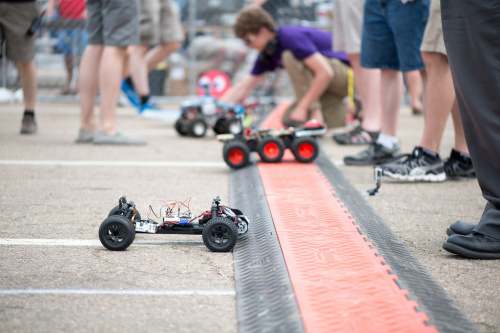
I just noticed this picture on the Sparkfun AVC2015 site:

That's from AVC 2014, and that is Yukari II, breadboard and everything. Those are my toes on the right.

Thursday, April 30, 2015

Analysis of Ender Quarry Mechanics


Abstract: The code of the Ender Quarry mod is analyzed, paying particular attention to what affects mining speed. The fastest the quarry can mine is 180 blocks/second. It might take half a million RF/tick to power a quarry going that fast. If you are power limited, adding speed upgrades beyond Speed I will make your quarry slower, not faster.

The Ender Quarry is not open source, but with Java Decompiler it becomes such. The code is uncommented, but most of the variable names are still in place, so it is pretty easy to figure out what is going on. I am using ExtraUtilities 1.2.4b . The code is not obfuscated, except to the degree that interfacing with obfuscated Minecraft requires it. For deobfuscation when required, I used the tables for Minecraft 1.7.10 provided by ModCoderPack 9.08 (but just the tables, not the program).

Monday, December 15, 2014

The Useless Machine

Once upon a time, I accidentally designed and built an electronic circuit that turned itself off, therefore accidentally re-inventing the Useless Machine. My nephew saw a YouTube video of one, and fell in love with the concept. So I got one:

It's a quite elegant machine, in that it is completely powered off when closed, and runs on two switches, with no other logic, no ICs, no nothing. It's circuit is a DPDT toggle switch, which appears to be the "on/off" switch but is more accurately referred to as the "forward/reverse" switch. It also has a microswitch inside which trips when the arm pulls all the way in. When the switch is forward, the motor runs forward until the arm pops out, collides with the switch, and puts it into reverse. The reverse circuit switch is in series with the microswitch, so it only runs until the arm retracts completely. It's kind of an interesting logic problem: How do you arrange the switches to do what is desired?


Sunday, July 13, 2014

St Kwan's Campanile is complete!

My name is Kwanzymandias, king of villagers: Look on my works, ye Mighty, and despair!


This is a full-scale model of the bell tower in St Mark's Square. I searched for days, making camp three times before discovering this village in a lake, about 150m from the third camp. I created this whole world with the express intent to find such a village, and when I did, I defended it and built my base there.

It's not quite The One Eight, yet, but it does have some nifty features. It is 102m tall, including the Tower of Shininess on the roof, consisting of one obsidian and four gold blocks. Its floor plan is a square 12m on a side, with walls 2m thick, just like the real thing. It shares with the real tower a spiral ramp around an empty center. The interior space is marked by four brick pillars, with a 4m square space in between them and the 1m wide ramp around them. Unlike the real tower, this is a working building, crammed to the gills with FTB technology. There is a floor in the center space every 6m, once per lap of the ramp.

The first floor is the lobby, and has nothing.

The second floor is the power station. It features the building tesseract, used to pipe lava from the pumping station in the Nether. The power station consists of 10 magma dynamos running on the lava pumped in, and their power goes out through the tesseract to power the pump. Until the local Nether lava ocean is drained, I will have power.

The third floor is the main AE room, with a 4m MAC, along with the controller, drive, and crafting terminal and monitor. My power armor tinker table is also here.

The fourth and fifth floors are gardens, with automatic planters and harvesters. These were used to grow earth and water seeds, used to make clay, then bricks for the walls (the walls were made of dirt first). The fifth floor also has the Tinker's Construct station for fixing tools.

The sixth floor is the chicken factory. It uses Xisuma's chicken cooker design to make several cooked chickens per hour, more than enough for my needs.

The seventh floor is the Nether portal room, with a floor of soul sand for growing nether wart.

The eighth floor is the twilight and Mystcraft portal room.

The ninth floor is just below the transition from brick to marble, and has the ore processing system. More buildcraft-type machines will go here as I need them.

The tenth floor is the belfry, where the big arched windows are. Here I have the bedroom, as well as a second crafting terminal, unifier, and uncrafting table. I plan to hang some note blocks from the ceiling to simulate the bells.

The eleventh floor is where the redstone for the bells will go.

The twelfth floor is not spoken for, it is the brick area above the marble and below the roof.

The thirteenth floor is under the roof, and is also not spoken for. I had planned at one point to put a mob farm here (in the dark) and have the mobs plummet through the tower, but I don't need any mob farms at the moment.

Wednesday, September 19, 2012

Around the world in (considerably less than) 80 hours

A thought experiment. I would need to go home and throw some stuff in a backpack, and get my passport, but this is doable. It was 2012 Sep 19 11:00am MDT as I searched.


Layover From Depart Arrive Flight Time
Airport TZ UTC rel Local UTC Local UTC


Boulder Mountain Daylight Time -6 2012 Sep 19 11:00AM 2012 Sep 19 17:00 2012 Sep 19 11:00AM 2012 Sep 19 17:00 Look up flight 00h00m
09h45m Denver (DEN) Mountain Daylight Time -6 2012 Sep 19 08:45PM 2012 Sep 20 02:45 2012 Sep 20 12:35PM 2012 Sep 20 11:35 American 6169 as British Airways 218 08h50m
02h10m London (LHR) British Summer Time 1 2012 Sep 20 02:45PM 2012 Sep 20 13:45 2012 Sep 21 12:50AM 2012 Sep 20 20:50 Etihad 20 07h05m
01h35m Abu Dhabi (AHU) Gulf Standard Time 4 2012 Sep 21 02:25AM 2012 Sep 20 22:25 2012 Sep 21 03:25PM 2012 Sep 21 07:25 Etihad 424 09h00m
07h05m Manila (MNL) Philippine Time 8 2012 Sep 21 10:30PM 2012 Sep 21 14:30 2012 Sep 21 08:00PM 2012 Sep 22 03:00 Philippine 104 12h30m
09h50m San Francisco (SFO) Pacific Daylight Time -7 2012 Sep 22 05:50AM 2012 Sep 22 12:50 2012 Sep 22 09:21AM 2012 Sep 22 15:21 United 729 02h31m
1d06h25m Total Layover


Total trip time 2d12h36m Total flight time 1d15h56m
Also as of 11:00am, this flight had a cost of $5,351.89. I couldn't swing that right now, and I have work to do for the next few days, but Phileas Fogg wouldn't have any such trouble. He had £20000 cash in his pocket, and this trip would cost about £55.16 There are probably possible trips with tighter connections. There are surely trips that are cheaper with a longer lead time -- I found one in January for ~$3500.

This trip is definitely around the world. It crosses all the meridians. But, it is only 32833km as the crow flies. I have heard that a trip around the world must cover a distance longer than one of the tropic circles (36787km). This trip doesn't cut it if it follows the great circle route, but if the actual routing is 10% inefficient then it counts.