The Arduino Leonardo can effectively be thought of as an Arduino on a chip, except that an Arduino pretty much already is one chip. What makes a Leonardo special is that its core is an ATMega32U4, which has a USB port. The chip can be programmed as normal over ISP, and once it is programmed with the appropriate Arduino bootloader, it can be programmed over the USB port. The Arduino library for Leonardo also supports using the USB as a CDC serial port, and has much other USB support.
The chip only runs at 8MHz. It can run at 16MHz at 5V, but I am planning on running it in the Rocketometer, which only has 3.3V available, which limits the chip to the aforementioned 8MHz.
Now how do I think I can get away with this? Simple: Even with the LPC2148 running at 60MHz, it was spending most of its time waiting for the bits to crawl across the I2C and SPI buses. And how much can we optimize a busy wait loop?
I bought a Leonardo to practice with, and a Sparkfun Pro Micro to practice some more, especially programming the bootloader. I will not be using the 6-pin ISP header on the Rocketometer, but I got the great idea to use the MicroSD sniffer to get at the SPI signals through the Rocketometer MicroSD slot, and I can just hold down the reset button, or solder one wire to the contact of the Reset switch - which reminds me, I should put the solder bridge on the top side of the reset switch. In that case, I can use the solder bridge itself as a temporary terminal, solder a wire to it long enough to program, connect the rest of the SPI signals to the microSD sniffer, then program it with an ArduinoISP.
While I was at it, I also designed a Precision clock around this new chip. It doesn't need a hardware UART to program or talk to the host computer, so no FT232 and no multiplexer is needed. The chip has more pins, so this design doesn't use literally every single possible pin (those two ADC-only pins don't count, since they are not possible to use in this project).
Wednesday, May 29, 2013

Monday, May 13, 2013
NTRS is back!
I am happy to say that I was wrong about NTRS. Plus, the EDL kernel has been released (at least is present on NAIF).
I know what we're doing tonight.
I know what we're doing tonight.
Sunday, April 28, 2013
DirectTask and nested interrupts
One problem with the old rocketometer code is that the sensor readout and SD card writing code were in the same thread, meaning that when the SD card took its endless milliseconds to write the data, the sensors were not being read, leaving an irregular gap in the record. My brilliant idea was to read the sensors in a task at interrupt priority, effectively creating another thread. First effort was with the task manager I described below, which was a dismal failure.
For whatever reason, and perhaps the same reason (see below), the task was not able to read the sensors. I came up with a much simpler task manager with which I am getting incredible accuracy.
I call it the DirectTask manager. Its concept: Rather than using one match channel of the timer and a heap priority queue, we just use all three available match channels (there are four, but the zeroth channel resets the timer every 1 minute). This limits the flexibility enormously, but I only need two tasks. I set up one task to reschedule itself on a regular basis (5ms in my first test) and I use the other task to read the BMP sensor.
However, the sensor readout runs an I2C read, which itself is interrupt driven. The code does not currently support nested interrupts, which means all interrupts are delayed until the current one returns. The I2C state machine was interrupt drive, and its interrupts were getting delayed, including the one which makes the state machine stop waiting forever, so the state machine waited forever.
So, we put in an option to I2C to run without interrupts, instead using a busy loop to check the I2C interrupt status bit, then calling the same state machine driver. We weren't getting anything by being interrupt driven anyway, since we had to wait for the read to finish.
With that, the DirectTask manager worked fine. Maybe the heap task manager would have worked fine too, but this one is simpler.
It takes 641 microseconds to read the sensors. We could probably easily bump the read rate to 500Hz, and maybe to 1000Hz, but this doesn't count anything but reading the MPU and HighAcc sensors.
For whatever reason, and perhaps the same reason (see below), the task was not able to read the sensors. I came up with a much simpler task manager with which I am getting incredible accuracy.
I call it the DirectTask manager. Its concept: Rather than using one match channel of the timer and a heap priority queue, we just use all three available match channels (there are four, but the zeroth channel resets the timer every 1 minute). This limits the flexibility enormously, but I only need two tasks. I set up one task to reschedule itself on a regular basis (5ms in my first test) and I use the other task to read the BMP sensor.
However, the sensor readout runs an I2C read, which itself is interrupt driven. The code does not currently support nested interrupts, which means all interrupts are delayed until the current one returns. The I2C state machine was interrupt drive, and its interrupts were getting delayed, including the one which makes the state machine stop waiting forever, so the state machine waited forever.
So, we put in an option to I2C to run without interrupts, instead using a busy loop to check the I2C interrupt status bit, then calling the same state machine driver. We weren't getting anything by being interrupt driven anyway, since we had to wait for the read to finish.
With that, the DirectTask manager worked fine. Maybe the heap task manager would have worked fine too, but this one is simpler.
It takes 641 microseconds to read the sensors. We could probably easily bump the read rate to 500Hz, and maybe to 1000Hz, but this doesn't count anything but reading the MPU and HighAcc sensors.
Wednesday, April 24, 2013
Flight Level 390 and autopilots
Started reading an interesting blog - Flight Level 390 by an airliner pilot who obviously wishes to remain anonymous.
One of the interesting things he pointed to was an incident where the ground crew turned off the pressurization system of a 737, failed to turn it back on, and the flight crew failed three times during the preflight check to turn it back on. As a result, the plane never pressurized on the way up on its flight from Cyprus to Athens, Greece. The oxygen masks in back dropped at 18000 feet, and no communications from the crew happened after the plane flew through 28000 feet. Presumably the crew lost consciousness at this point.
The interesting thing to me is what happened next. The autopilot leveled off at its flight plan altitude of 34000 feet, flew to Athens automatically, and then entered the holding pattern. The program did exactly what it was supposed to do at that point, wait for further instructions, which never came. After flying for almost 3 hours, the plane ran out of fuel and plummeted to the ground.
I find it amazing that the autopilot could be programmed to do that -- not that it is technically difficult, but that they bothered to do it. I always think of an autopilot as more of just a wing leveller and maybe a beam follower. I would have supposed that the plane would get to Athens or wherever the end of its beam was, then keep flying straight and level in the same direction.
If you can program an autopilot to do that, it's not that big of a jump to complete auto control of the whole flight, with the human crew there just to be able to think on their feet if there is trouble. And here then is the interesting part. In my previous essay on the interaction between pilots and automation, I advocated a system where each part of the system was assigned to the component that could do it best. In that case it was lunar landing, where the computer calculated the best course to the landing spot while the human used his vision and judgement to select that spot. In this case, we assign most of the actual flying to the autopilot and assign oversight and handling of emergencies to the human crew. But, here is where the human and autopilot system are anti-complimentary. The human crew will have very little to do during the 999,999 flights in 1,000,000 where nothing happens. A crew member might go his entire career without ever seeing a true emergency, although I have been on enough flights to know that a good chunk of them try to fly over, under, or around turbulence. Is the latter just a matter of dialing a different number into the altitude hold?
Maybe the autopilot could have been programmed to descend to 18000 feet if it detects a pressure loss (the masks dropping) and gets no command inputs for several minutes. Will this incident type ever happen again? Maybe, ever is a long time. It turns out that the system did have a pressurization alarm, which worked, but the alarm was the same sound as one which can only occur on the ground. The crew thought it was the alarm for the thing that can only happen on the ground, and therefore ignored it as a bad alarm.
The point is, you become good at what you practice, and lose ability at what you don't. If a crew is mind-numbed by 10,000 hours of babysitting an autopilot, what makes us think that the humans will actually be able to handle an emergency? Air France 447 seems to have run into just that sort of difficulty. They crew was so used to the autopilot and fly-by-wire handling things, that when those programs shut down, the human pilot didn't remember how to fly that high up, and stalled the plane for 35000 feet while believing that the fly-by-wire would keep the plane from stalling.
But here's the thing. When autopilots work, they work better than human pilots. They don't make the same kinds of mistakes as human pilots. And, even if the system was fully manual, being mind-numbed by holding the yoke in place for 10,000 hours is no better training for an emergency.
I look at how astronauts trained for the Apollo missions and I see how football teams practice. They spend at least ten times as much time practicing as they do in the event. I look at how airliners are flown and I see how baseball players and basketball players and basketball band musicians practice -- by playing the game. By performing. By actually doing it every single day.
The airlines are doing something right. They fly 10 million operations per year, and there have been no fatal airline crashes in the United States since 2009. Maybe this is just as good as it gets.
One of the interesting things he pointed to was an incident where the ground crew turned off the pressurization system of a 737, failed to turn it back on, and the flight crew failed three times during the preflight check to turn it back on. As a result, the plane never pressurized on the way up on its flight from Cyprus to Athens, Greece. The oxygen masks in back dropped at 18000 feet, and no communications from the crew happened after the plane flew through 28000 feet. Presumably the crew lost consciousness at this point.
The interesting thing to me is what happened next. The autopilot leveled off at its flight plan altitude of 34000 feet, flew to Athens automatically, and then entered the holding pattern. The program did exactly what it was supposed to do at that point, wait for further instructions, which never came. After flying for almost 3 hours, the plane ran out of fuel and plummeted to the ground.
I find it amazing that the autopilot could be programmed to do that -- not that it is technically difficult, but that they bothered to do it. I always think of an autopilot as more of just a wing leveller and maybe a beam follower. I would have supposed that the plane would get to Athens or wherever the end of its beam was, then keep flying straight and level in the same direction.
If you can program an autopilot to do that, it's not that big of a jump to complete auto control of the whole flight, with the human crew there just to be able to think on their feet if there is trouble. And here then is the interesting part. In my previous essay on the interaction between pilots and automation, I advocated a system where each part of the system was assigned to the component that could do it best. In that case it was lunar landing, where the computer calculated the best course to the landing spot while the human used his vision and judgement to select that spot. In this case, we assign most of the actual flying to the autopilot and assign oversight and handling of emergencies to the human crew. But, here is where the human and autopilot system are anti-complimentary. The human crew will have very little to do during the 999,999 flights in 1,000,000 where nothing happens. A crew member might go his entire career without ever seeing a true emergency, although I have been on enough flights to know that a good chunk of them try to fly over, under, or around turbulence. Is the latter just a matter of dialing a different number into the altitude hold?
Maybe the autopilot could have been programmed to descend to 18000 feet if it detects a pressure loss (the masks dropping) and gets no command inputs for several minutes. Will this incident type ever happen again? Maybe, ever is a long time. It turns out that the system did have a pressurization alarm, which worked, but the alarm was the same sound as one which can only occur on the ground. The crew thought it was the alarm for the thing that can only happen on the ground, and therefore ignored it as a bad alarm.
The point is, you become good at what you practice, and lose ability at what you don't. If a crew is mind-numbed by 10,000 hours of babysitting an autopilot, what makes us think that the humans will actually be able to handle an emergency? Air France 447 seems to have run into just that sort of difficulty. They crew was so used to the autopilot and fly-by-wire handling things, that when those programs shut down, the human pilot didn't remember how to fly that high up, and stalled the plane for 35000 feet while believing that the fly-by-wire would keep the plane from stalling.
But here's the thing. When autopilots work, they work better than human pilots. They don't make the same kinds of mistakes as human pilots. And, even if the system was fully manual, being mind-numbed by holding the yoke in place for 10,000 hours is no better training for an emergency.
I look at how astronauts trained for the Apollo missions and I see how football teams practice. They spend at least ten times as much time practicing as they do in the event. I look at how airliners are flown and I see how baseball players and basketball players and basketball band musicians practice -- by playing the game. By performing. By actually doing it every single day.
The airlines are doing something right. They fly 10 million operations per year, and there have been no fatal airline crashes in the United States since 2009. Maybe this is just as good as it gets.
Wednesday, April 3, 2013
They took down NTRS
Back when NASA was testing the X-43, they said something that has stuck in my mind ever since. The X-43 is a scramjet test vehicle. The thing is boosted on a Pegasus to near mach 10, then the scramjet is fired for 10 seconds. Afterwards, the vehicle is not recovered. "The only thing we get back from this mission is data."
When you think about it that way, all the robotic space missions are like that. We just get back data. No artifacts, no samples, just bits. We then assemble those bits back into knowledge back here on the ground. When we talk about the $800M SDO mission, we are spending the $800M to get those bits, so they better be valuable. Furthermore, I paid for those bits so I should have access to them.
The NASA Technical Report Server is where the knowledge collected from those bits go. It is now closed.
They claim that it is due to an ITAR review, and that it will be reopened when that is complete. There are over a million papers on NTRS. That is never going to get the kind of review they are implying.
So: For all those mission that only send back data, the only evidence that we have that they even happened is now gone. We spent $XB a year on NASA, and what we paid for is now locked up. This is a bad precedent. Furthermore, the NASA library is now untrustworthy. We build libraries to hold knowledge, and if they close at random without notice, they fail to serve their purpose.
Similarly, I now don't think that the kernels for reconstructed entry of MSL will ever be released.
This is not a good way to start the day.
When you think about it that way, all the robotic space missions are like that. We just get back data. No artifacts, no samples, just bits. We then assemble those bits back into knowledge back here on the ground. When we talk about the $800M SDO mission, we are spending the $800M to get those bits, so they better be valuable. Furthermore, I paid for those bits so I should have access to them.
The NASA Technical Report Server is where the knowledge collected from those bits go. It is now closed.
They claim that it is due to an ITAR review, and that it will be reopened when that is complete. There are over a million papers on NTRS. That is never going to get the kind of review they are implying.
So: For all those mission that only send back data, the only evidence that we have that they even happened is now gone. We spent $XB a year on NASA, and what we paid for is now locked up. This is a bad precedent. Furthermore, the NASA library is now untrustworthy. We build libraries to hold knowledge, and if they close at random without notice, they fail to serve their purpose.
Similarly, I now don't think that the kernels for reconstructed entry of MSL will ever be released.
This is not a good way to start the day.
Tuesday, March 26, 2013

Thursday, March 21, 2013
Pinewood Derby and single-track Gray codes
It's time for the anuual Pinewood Derby at the cub scout pack I serve. Last year I was out of town during the Derby so I didn't participate. This year I am here, so I am making a car. I am not competing, of course, so I am free of certain constraints. Also, I never do any project like this in some ordinary way. As Emeril would say, I always try to kick it up a notch.
The design of the car is a pretty simple one, inspired by my first car back when I was in Cub Scouts. That year, we (me and my parents) thought aerodynamics was the most important thing, and so we designed the car accordingly. And finished dead last. Anyway, I still have fond memories of that car, like trying to microwave the car to dry the paint and charring the center of the block, nailing AA batteries to the back, putting my Battlestar Galactica 2" pilot action figure as a pilot. The general car design had a duckbill front and a turtle back. It was also solid red (what color do we hate?).
This time I have nicely polished the block to the point that it shines. I am going to leave the block completely unmarked.
But, that's not kicking it up a notch. Kicking it up a notch is installing a rocket engine in it. It's installing a camera. It's installing an electric motor. It's putting in a sensor for the car to time itself. I'm going to do the latter.
I have painted the back right wheel half white, including the tread, but with the hub very carefully masked off so as to not interfere with spinning. Over that wheel, I have installed two QRD1114 line-follower sensors. Each includes a near-infrared LED and a phototransistor. The sensor is close enough to visible light that things like white paint are still white and black is still black. The two sensors are placed roughly 90deg apart around the wheel, and about 1-2mm away from the tread. The idea is that the sensors use the half-white wheel as a single-track Gray code encoder wheel. Thinking about it this way: Suppose the car is rolling, the back sensor is well over the white part, but the front sensor just transitioned from black to white. Which way did the wheel turn? It must have been forward. If the back sensor were white but the front sensor changed from white to black, that means the wheel turned backward. Using this, we can construct a directional odometer, and measure the distance the car has moved. By timing the transitions, we can measure the speed of the car as well. By properly using both sensors, we can always know the direction of wheel spin and the orientation of the wheel to within a quarter turn.

So, the car will measure its own speed. We start the car with the wheel just past ticking over, so it has to turn one full time to count a rotation. The wheels are 15mm in radius, so we can measure the distance traveled. The microcontroller reading these sensors has a clock with microsecond precision and 4-microsecond resolution, so plenty enough to measure the exact time of each wheel rotation. Putting these together gives the car's speed, which it will print on an LCD display.
The gem this week is Gray code encoders, in particular single-track encoders. These have one track of code, and several sensors over that track at different angular positions. You need one sensor for every bit of code (two in my case for a 2-bit, 4 position code), but with careful design of the code track, you can use the same track for different bits, by shifting the sensors around the wheel a bit. This can be continued until you use the same track for all the sensors.
The design of the car is a pretty simple one, inspired by my first car back when I was in Cub Scouts. That year, we (me and my parents) thought aerodynamics was the most important thing, and so we designed the car accordingly. And finished dead last. Anyway, I still have fond memories of that car, like trying to microwave the car to dry the paint and charring the center of the block, nailing AA batteries to the back, putting my Battlestar Galactica 2" pilot action figure as a pilot. The general car design had a duckbill front and a turtle back. It was also solid red (what color do we hate?).
This time I have nicely polished the block to the point that it shines. I am going to leave the block completely unmarked.
But, that's not kicking it up a notch. Kicking it up a notch is installing a rocket engine in it. It's installing a camera. It's installing an electric motor. It's putting in a sensor for the car to time itself. I'm going to do the latter.
I have painted the back right wheel half white, including the tread, but with the hub very carefully masked off so as to not interfere with spinning. Over that wheel, I have installed two QRD1114 line-follower sensors. Each includes a near-infrared LED and a phototransistor. The sensor is close enough to visible light that things like white paint are still white and black is still black. The two sensors are placed roughly 90deg apart around the wheel, and about 1-2mm away from the tread. The idea is that the sensors use the half-white wheel as a single-track Gray code encoder wheel. Thinking about it this way: Suppose the car is rolling, the back sensor is well over the white part, but the front sensor just transitioned from black to white. Which way did the wheel turn? It must have been forward. If the back sensor were white but the front sensor changed from white to black, that means the wheel turned backward. Using this, we can construct a directional odometer, and measure the distance the car has moved. By timing the transitions, we can measure the speed of the car as well. By properly using both sensors, we can always know the direction of wheel spin and the orientation of the wheel to within a quarter turn.
 |
| I was disappointed to see that Bele and Lokai wear gray gloves. Bele doesn't wear gloves here! |

So, the car will measure its own speed. We start the car with the wheel just past ticking over, so it has to turn one full time to count a rotation. The wheels are 15mm in radius, so we can measure the distance traveled. The microcontroller reading these sensors has a clock with microsecond precision and 4-microsecond resolution, so plenty enough to measure the exact time of each wheel rotation. Putting these together gives the car's speed, which it will print on an LCD display.
The gem this week is Gray code encoders, in particular single-track encoders. These have one track of code, and several sensors over that track at different angular positions. You need one sensor for every bit of code (two in my case for a 2-bit, 4 position code), but with careful design of the code track, you can use the same track for different bits, by shifting the sensors around the wheel a bit. This can be continued until you use the same track for all the sensors.
Wednesday, March 20, 2013
Rocketometer Flight Test 1 and photos
3/16/2013 Flight 1
Site: Alpine Elementary field
Weather: Overcast, calm winds during flight, weather at KCOLONGM64 51.5f 29.97 in 6.7mph 49%RH
Hardware: Rocketometer6050 #2, Estes Star Stryker (modified)
Forgot to pull cap from launch rod before flight. Flew straight, seemed to turn level to ground at apogee, I could see a yellow tinge to the tracking smoke. Parachute ejected but never inflated. Rocket fell free from apogee. Rocketometer was still running after flight. Engine hook unzipped about 1/8 inch to the aft, probably due to ejection. One fin has a cracked glue joint. Minor ding to rocket nose cone due to striking launch rod cap. Rocket could probably be repaired, but not reflown in its current condition.
No video of the flight was captured. I had the camera, forgot to press record.
Rocketometer has one file as expected, RKTO0500.SDS 35,369,984 bytes. Indicates that Rocketometer was running through whole flight.
Switch and card not glued into place. Reset solder bridge in place. Rocketometer ran through flight anyway, indicating that nothing was jarred loose.
Rocketometer on internal power ~11:50am
Nautilus reports weird file sizes for files. fsck.vfat does not report any filesystem errors.
Total packets retrieved: 1,572,103
AD377 STRUCT = -> <Anonymous> Array[124694]
BMP2 STRUCT = -> <Anonymous> Array[6234]
DEF STRUCT = -> <Anonymous> Array[15]
DUMPDATA BYTE = Array[65640]
F STRING = 'RKTO0500.SDS'
HMC STRUCT = -> <Anonymous> Array[124694]
INF LONG = 100
MPU STRUCT = -> <Anonymous> Array[1246947]
N_EXTEND LONG = -59604
N_PACKETS ULONG = Array[2048]
OUF LONG = 100
PKT STRUCT = -> <Anonymous> Array[1]
STATUS INT = 0
TCC STRUCT = -> <Anonymous> Array[68932]
T_PACKETS ULONG = 1572103
Greater than 26 minutes of data recorded. Processing took about 14 minutes.
Time stamp difference between first MPU record and last: 1601.1205s (26m41.1205s)
Range zero is 1058s (last top of second before first acceleration)
MPU did saturate during boost


Site: Alpine Elementary field
Weather: Overcast, calm winds during flight, weather at KCOLONGM64 51.5f 29.97 in 6.7mph 49%RH
Hardware: Rocketometer6050 #2, Estes Star Stryker (modified)
Forgot to pull cap from launch rod before flight. Flew straight, seemed to turn level to ground at apogee, I could see a yellow tinge to the tracking smoke. Parachute ejected but never inflated. Rocket fell free from apogee. Rocketometer was still running after flight. Engine hook unzipped about 1/8 inch to the aft, probably due to ejection. One fin has a cracked glue joint. Minor ding to rocket nose cone due to striking launch rod cap. Rocket could probably be repaired, but not reflown in its current condition.
No video of the flight was captured. I had the camera, forgot to press record.
Rocketometer has one file as expected, RKTO0500.SDS 35,369,984 bytes. Indicates that Rocketometer was running through whole flight.
Switch and card not glued into place. Reset solder bridge in place. Rocketometer ran through flight anyway, indicating that nothing was jarred loose.
Rocketometer on internal power ~11:50am
Nautilus reports weird file sizes for files. fsck.vfat does not report any filesystem errors.
Total packets retrieved: 1,572,103
AD377 STRUCT = -> <Anonymous> Array[124694]
BMP2 STRUCT = -> <Anonymous> Array[6234]
DEF STRUCT = -> <Anonymous> Array[15]
DUMPDATA BYTE = Array[65640]
F STRING = 'RKTO0500.SDS'
HMC STRUCT = -> <Anonymous> Array[124694]
INF LONG = 100
MPU STRUCT = -> <Anonymous> Array[1246947]
N_EXTEND LONG = -59604
N_PACKETS ULONG = Array[2048]
OUF LONG = 100
PKT STRUCT = -> <Anonymous> Array[1]
STATUS INT = 0
TCC STRUCT = -> <Anonymous> Array[68932]
T_PACKETS ULONG = 1572103
Greater than 26 minutes of data recorded. Processing took about 14 minutes.
Time stamp difference between first MPU record and last: 1601.1205s (26m41.1205s)
Range zero is 1058s (last top of second before first acceleration)
MPU did saturate during boost


 |
| Rocketometer loaded and ready for flight |
 |
| Flight battery is similar to this, not visible in rocket pictures since it is packed in foam behind the board. Photo from Sparkfun Electronics published under CC BY-NC-SA 3.0 |
 |
| Rocketometer rendering, showing sensor side |
 |
| Rocketometer rendering, showing interface side |
Sunday, March 10, 2013
More on Siding Spring
 | |
| Red circle - Mars impact locus. Green star - old nominal approach. Black ellipses - old 1,2,3 sigma. Blue dots - new Monte Carlo samples. Orange rings - new 1,2,3 sigma ellipses according to Monte Carlo |
Tuesday, March 5, 2013
Comet C/2013 A1 (Siding Spring)
 | ||
|
What's in a name?
First off, the name is C/2013 A1, which means that it is a C/ non-periodic comet (this is the first recorded observation of the object) 2013 A discovered in the first half of January 2013, 1 first comet discovered in that part of the month. Siding Spring is parenthetical and not part of the name, just the name of the observatory that discovered it, but since it's easier to remember than a number, we will probably end up hearing a lot about comet Siding Spring.Why do we care?
The comet is on a very close-approach to Mars. We care about Mars because we care about the spacecraft present in orbit and on its surface. Even more interestingly, the 1-sigma uncertainty ellipse currently includes Mars. There is about a 1 in 1000 chance of impact.What are its effects likely to be?
- If it hits Mars, it will almost certainly throw enough junk into low Mars space to kill all the spacecraft in orbit. It is also likely to kill any rover which happens to be within several hundred kilometers.
- If it misses, well it's a comet visible from 7+ AU out. It's going to be a big'un. All the usual stuff that applies to comets will apply here. It is likely that Mars (and therefore all the satellites) will pass through the coma, and be subjected to a pretty good sandblasting. We will need to review our experience with the Halley armada, and consider that the closer-passing objects were armored.
- If we decide that the comet is a hazard to spacecraft and other mechanical things, we have to decide what to do with Maven. Do we hold it until the next window? Is it worth firing to get a month's worth of data?
Details
I have been watching this for the past week, and while refined orbits have been produced, the nominal miss distance has been shrinking, and impact has not been excluded yet. The last solution I have seen gives a 0.016% chance of impact.In particular, Horizons says that the 3-sigma uncertainty ellipse has a semi-major axis of 88000km, a semi-minor axis of 22000km, and that the smallest uncertainty ellipse which touches Mars has a value of 0.98 sigmas. Further, the ellipse is rotated 24.20deg from the line between closest approach. I ran all this through an IDL script and got the plot at the top of this article.
I believe that the documentation on Horizons is wrong, and that what is documented as the 3-sigma uncertainty ellipse major and minor is really the 1-sigma ellipse. With this change, the Monte Carlo samples (see below) match the error ellipses well. Otherwise, I can't reconcile the 3-sigma ellipse touching Mars with the reported Nsigma of 0.98.
A new and powerful tool
The Minor Planet Center collects observations, and in principle you can fit those observations yourself, if your name is Carl Friedrich Gauss. Or if you get Find_orb from Project Pluto. I'm still learning it myself and playing with it, but it has the ability to import observations in MPC format. The program is under active development, and appears to have accreted features as interesting real-world events have happened. For our purpose, the two best features are auto-fit and Monte Carlo. The latter is done in an especially clever way. The program creates a cloud of objects, but it doesn't require a covariance matrix. Instead, it adds a bit of noise to each observation in RA and Dec, then fits an orbit to those new observations and creates an object.So, I got the observations for C/2013 A1 and dropped them in. After 5015 Monte Carlo samples, 7 of them hit Mars, for an impact probability of 0.14%, quite in line with the JPL Horizons number, but produced directly and solely from the observations. As seen above, they almost perfectly fit the JPL Horizons ellipses.
Friday, February 15, 2013
2012 DA14 in Celestia
1) Go to Horizons and get the spice kernel
telnet ssd.jpl.nasa.gov:6775
type 2012 DA14, and say yes to do a name search. Once it finds it, type s to get an SPK kernel. Give the following answers:
SPK text transfer format [ YES, NO, ? ] : n
SPK object START [ t >= 1900-Jan-01, ? ] : 2013-Feb-01
SPK object STOP [ t <= 2101-Jan-01, ? ] : 2013-Mar-01
Binary SPK will be created, you will be asked to add more objects, say n.
Now you will get a download link, copy it to your browser and save it. It will be named something like wld17761.16.
2) Install Celestia
3) Create an extra for Celestia
Create a text file 2012_DA14.ssc in the extras folder and create a data folder within that folder. I needed to run a text editor as administrator to do this.
In the text file, paste the following text:
"2012 DA14" "Sol"
{
Class "asteroid"
Texture "asteroid.jpg"
Color [ 1.000 0.960 0.919 ]
BlendTexture true
Radius 0.025
SpiceOrbit
{
Kernel "2012_DA14.bsp"
Target "3599602"
Origin "SUN"
Beginning "2013 2 13"
Ending "2013 2 17"
BoundingRadius 1.5
Period 1.0
}
UniformRotation
{
Period 5.918
}
Albedo 0.048
}
4) Copy the spice kernel wld12345.16 to the extras/data folder and rename it 2012_DA14.bsp
5) Start up Celestia and look for 2012 DA14 in the solar system browser. It should be the last item under Sol. If it's not there, use ~ to bring up the debug screen and up and down to scroll it, and see if there are any errors for 2012 DA14.
Closest observed distance is just under 30000km. It travels from south to north past the night side of Earth.
telnet ssd.jpl.nasa.gov:6775
type 2012 DA14, and say yes to do a name search. Once it finds it, type s to get an SPK kernel. Give the following answers:
SPK text transfer format [ YES, NO, ? ] : n
SPK object START [ t >= 1900-Jan-01, ? ] : 2013-Feb-01
SPK object STOP [ t <= 2101-Jan-01, ? ] : 2013-Mar-01
Binary SPK will be created, you will be asked to add more objects, say n.
Now you will get a download link, copy it to your browser and save it. It will be named something like wld17761.16.
2) Install Celestia
3) Create an extra for Celestia
Create a text file 2012_DA14.ssc in the extras folder and create a data folder within that folder. I needed to run a text editor as administrator to do this.
In the text file, paste the following text:
"2012 DA14" "Sol"
{
Class "asteroid"
Texture "asteroid.jpg"
Color [ 1.000 0.960 0.919 ]
BlendTexture true
Radius 0.025
SpiceOrbit
{
Kernel "2012_DA14.bsp"
Target "3599602"
Origin "SUN"
Beginning "2013 2 13"
Ending "2013 2 17"
BoundingRadius 1.5
Period 1.0
}
UniformRotation
{
Period 5.918
}
Albedo 0.048
}
4) Copy the spice kernel wld12345.16 to the extras/data folder and rename it 2012_DA14.bsp
5) Start up Celestia and look for 2012 DA14 in the solar system browser. It should be the last item under Sol. If it's not there, use ~ to bring up the debug screen and up and down to scroll it, and see if there are any errors for 2012 DA14.
Closest observed distance is just under 30000km. It travels from south to north past the night side of Earth.
Friday, February 8, 2013
Gem of the Week - On-Demand Printing
The Big One, by Stuart Slade. World War II went very differently, with England basically surrendering after Dunkirk, immediately drawing the USA into the war. With the Western front secure, Germany was able to focus on the Russian front. They captured Moscow (and killed Stalin, good riddance) but were stopped short of the Urals by the combined Russian and American armies, where they stalemated for five years.
One day in 1947, that changed. On that day, over a thousand planes were launched from bases all along the East Coast of the United states, carrying over 200 Mark III atomic bombs. These were upgraded from the Mk3 used in our timeline, with a typical yield of 35kT instead of the 20kT of Trinity and Fat Man. The main bombers were B-36s, with four bombs each. Each bomber had two escorts, also B-36s.
Interestingly, once the bombers were over Germany, they turned on Salvage Fuses, which would set the bombs off once they reached 2000ft, even if still in the plane. So even shooting down a bomber won't save you. In fact, the second blast was due to this very effect. That's just mean...
One hundred fifteen bombs are accounted for in the book, including twelve for Berlin, eight for Munich, and twenty-five between Dortmund and Bonn. Two were in the Frankfurt area, one in Koblenz, one in Heidelberg, but none in Rothenberg. Estimated casualties are twenty million immediate fatalities and probably that many again from radiation, lingering injuries, illness, and the collapse of civilization and famine caused thereby. The population of Germany was about 60 million in 1945, real world timeline.
It's an interesting story, but it has some holes in it, like how in the world did General Groves keep Manhattan secret for two additional years while they built up the stockpile? I got the book largely to see the answer to that question, but I didn't find it. Also, I am surprised they didn't base in Russia. However looking at the map, it is almost as far from the Front to Germany as it is all the way from America.
But none of that is the Gem. I found out about the Big One on the TV Tropes Wiki in late January, and after failing to find the story in free form on the net, I decided to shell out and buy the book on Friday, 1 Feb 2013. The last page of the book is marked:
One day in 1947, that changed. On that day, over a thousand planes were launched from bases all along the East Coast of the United states, carrying over 200 Mark III atomic bombs. These were upgraded from the Mk3 used in our timeline, with a typical yield of 35kT instead of the 20kT of Trinity and Fat Man. The main bombers were B-36s, with four bombs each. Each bomber had two escorts, also B-36s.
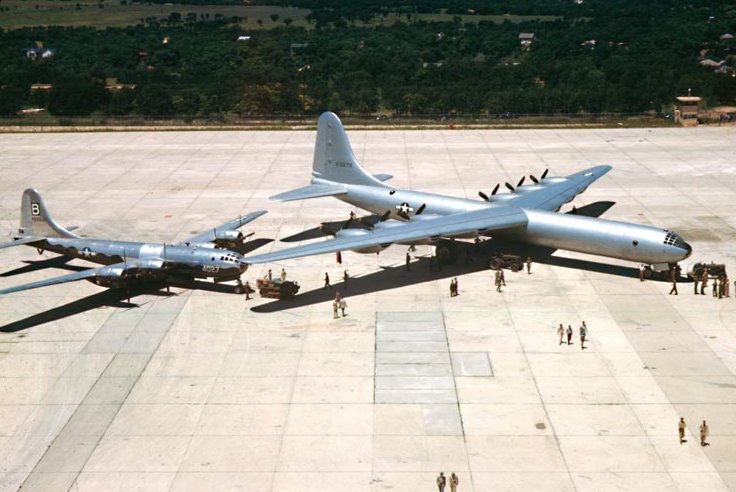 |
| That smaller plane to the left is a B-29. To put it mildly, the B-36 is a large aircraft. |
Interestingly, once the bombers were over Germany, they turned on Salvage Fuses, which would set the bombs off once they reached 2000ft, even if still in the plane. So even shooting down a bomber won't save you. In fact, the second blast was due to this very effect. That's just mean...
One hundred fifteen bombs are accounted for in the book, including twelve for Berlin, eight for Munich, and twenty-five between Dortmund and Bonn. Two were in the Frankfurt area, one in Koblenz, one in Heidelberg, but none in Rothenberg. Estimated casualties are twenty million immediate fatalities and probably that many again from radiation, lingering injuries, illness, and the collapse of civilization and famine caused thereby. The population of Germany was about 60 million in 1945, real world timeline.
It's an interesting story, but it has some holes in it, like how in the world did General Groves keep Manhattan secret for two additional years while they built up the stockpile? I got the book largely to see the answer to that question, but I didn't find it. Also, I am surprised they didn't base in Russia. However looking at the map, it is almost as far from the Front to Germany as it is all the way from America.
But none of that is the Gem. I found out about the Big One on the TV Tropes Wiki in late January, and after failing to find the story in free form on the net, I decided to shell out and buy the book on Friday, 1 Feb 2013. The last page of the book is marked:
Made in the USA
Lexington, KY
02 February 2013
The book was made after I ordered it. It seems that it was literally made for me.
Saturday, February 2, 2013
Gem of the Week - EEPROM I2C Memory
Of course I am designing a Rocketometer around the Propeller. How could it be otherwise?
In doing so, I have to get my own parts. The Sparkfun breakout is an interesting jumping-off point, but they don't even use bypass caps, so I added a set of those. Also one thing which concerns me about this whole endeavor is that all the memory is limited. Each cog gets 2kiB, for a total of 16kiB, but the images for each cog must be stored in main memory, which has 32kiB of RAM and 32kiB of ROM. There is no way that I am going to be able to get the program source code embedded with that little amount of memory.
This brings us back to the EEPROM on the breakout board. The bootloader burned into the Propeller knows how to bit-bang an I2C interface and read a memory on the bus. It treats the memory as a 32kiB byte-addressable memory with auto-increment, so it can set an address once, then read and read and read and fill main RAM. The Propeller documents say to use a 24LC256 or similar, so I got to looking at Digikey to see if they had that chip, and perhaps more interestingly, if there was a bigger chip which would still work. It turns out that the design of the EEPROM is the gem of the week.
First, the hardware. The 24LC256 is a 256kib memory organized as a 32ki x 8 (byte-addressable) memory. It is in a kind of large package, a whopping 5mm wide, with 8 pins. This is a lot for a device which is I2C and could in principle work with only 4 pins. But here is the cleverness. The device has three address pins, allowing the 7-bit I2C address to be anything in the range 0x50-0x57. So, you could just stack up to 8 devices on the bus, with only the address pins different, and get 32x8=256kiB of memory, at the cost of using 8 devices.
The 32kiB space is addressable with 15 bits, but the I2C protocol is byte-oriented, so you have to send 16 bits, of which only A0-A14 are considered, and A15 is ignored.
These facts work together to allow the address space to be easily extended. First, a 64kiB part is doable just by considering A15 in the address. Next, a device can internally answer more than one address, for instance by ignoring the A0 hardware pin and answering both 0x50 and 0x51. This of course means that you have to readdress the device when you cross from the address space covered by 0x50 and the one covered by 0x51. You would have to do that anyway if there were multiple real devices.
This all adds up to the STMicro M24M02, which appears to be compatible with the 24LC256, in that if you talk to an 'M02 like a '256, it will answer like a '256. So, you can use the larger device and the bootloader should happily just work. However, it is a 2Mib memory organized as 256ki x 8 (256kiB), eight times as much memory as the reference design, and approaching comparability with the LPC2148 and its 512kiB of Flash. Then when your application takes over, you can use your own bit-bang to access the full chip.
The 'M02 still has one address pin, so in principle you could make a 512kiB memory in 1 chip without changing anything. Going beyond this will break the nice de-facto protocol going on here.
In doing so, I have to get my own parts. The Sparkfun breakout is an interesting jumping-off point, but they don't even use bypass caps, so I added a set of those. Also one thing which concerns me about this whole endeavor is that all the memory is limited. Each cog gets 2kiB, for a total of 16kiB, but the images for each cog must be stored in main memory, which has 32kiB of RAM and 32kiB of ROM. There is no way that I am going to be able to get the program source code embedded with that little amount of memory.
This brings us back to the EEPROM on the breakout board. The bootloader burned into the Propeller knows how to bit-bang an I2C interface and read a memory on the bus. It treats the memory as a 32kiB byte-addressable memory with auto-increment, so it can set an address once, then read and read and read and fill main RAM. The Propeller documents say to use a 24LC256 or similar, so I got to looking at Digikey to see if they had that chip, and perhaps more interestingly, if there was a bigger chip which would still work. It turns out that the design of the EEPROM is the gem of the week.
First, the hardware. The 24LC256 is a 256kib memory organized as a 32ki x 8 (byte-addressable) memory. It is in a kind of large package, a whopping 5mm wide, with 8 pins. This is a lot for a device which is I2C and could in principle work with only 4 pins. But here is the cleverness. The device has three address pins, allowing the 7-bit I2C address to be anything in the range 0x50-0x57. So, you could just stack up to 8 devices on the bus, with only the address pins different, and get 32x8=256kiB of memory, at the cost of using 8 devices.
The 32kiB space is addressable with 15 bits, but the I2C protocol is byte-oriented, so you have to send 16 bits, of which only A0-A14 are considered, and A15 is ignored.
These facts work together to allow the address space to be easily extended. First, a 64kiB part is doable just by considering A15 in the address. Next, a device can internally answer more than one address, for instance by ignoring the A0 hardware pin and answering both 0x50 and 0x51. This of course means that you have to readdress the device when you cross from the address space covered by 0x50 and the one covered by 0x51. You would have to do that anyway if there were multiple real devices.
This all adds up to the STMicro M24M02, which appears to be compatible with the 24LC256, in that if you talk to an 'M02 like a '256, it will answer like a '256. So, you can use the larger device and the bootloader should happily just work. However, it is a 2Mib memory organized as 256ki x 8 (256kiB), eight times as much memory as the reference design, and approaching comparability with the LPC2148 and its 512kiB of Flash. Then when your application takes over, you can use your own bit-bang to access the full chip.
The 'M02 still has one address pin, so in principle you could make a 512kiB memory in 1 chip without changing anything. Going beyond this will break the nice de-facto protocol going on here.
Friday, January 25, 2013
Gem of the Week - the Parallax Propeller
I write this before ever using one, so consider this a review of the concept rather than the implementation. The Parallax Propeller is a microcontroller with a couple of interesting features, and perhaps more interestingly, a couple of intentionally missing features.
First off, it has no peripherals other than 32 GPIO pins.
Secondly, it has no such concept as interrupt.
Thirdly, it has eight independent processors, called "cogs", each with its own memory. Each one can run on its own resources without interfering with any other processor. Each cog is a 32-bit processor, and gets access to 2kiB of ram, shared between code and data.
Fourth, it has a set of resources that all processors can access, called a "hub". This basically consists of more memory and a round-robin memory controller which each cog can access in turn. The hub has 32kiB of ROM with the bootloader, Spin interpreter, and a couple of tables, and 32kiB of RAM.
The missing features are what make the controller interesting. Want an I2C? Write a program for a cog which can bit-bang it. Same for SPI, UART serial, etc. Presumably it could bit-bang low-speed USB, but high-speed would be difficult due to limited processor speed.
Further -- want an interrupt? Too bad. Instead, assign a cog to sleep-wait for the appropriate signal.
Programming such a beast is clearly a different problem than programming an ARM of any flavor. ARMs are all about peripherals, registers, interrupts, etc. Propeller is about bit-banging. Effectively you can use a cog as a soft-peripheral to do basically any digital process.
As I mentioned above, the processor comes with a Spin interpreter. Spin is a custom language for programming Propeller, which gets compiled into byte code and interpreted with the Spin virtual machine. Of course you give up performance, but they used an interpreter in the Apollo Guidance Computer. There, it was for memory saving - a single interpretive instruction could take the place of many instructions in AGC machine language. They gave up time to gain space. Spin could have similar benefits, but it seems like the main purpose is providing a language which natively handles the very different concepts needed to handle a processor as weird as the Propeller.
A Propeller program then consists of a bunch of Spin and machine language routines, all stored in hub RAM and copied from some external source whenever the chip resets. Aside from self-modification or using a cog to bit-bang a memory bus, this is all the space you get. This is a rather tight restriction, in fact less memory than in the AGC. But, they fit a full-blown Kalman filter into that.
Of course I have already designed it into a Rocketometer. It's what I do. One of the great things about the GPIO and bit-banging style of the Propeller is that I can put the SPI bus on the pins which are closest to their targets outside the chip. This makes routing the board MUCH easier.
So I will say for now that Propeller shows a lot of promise. The design is a gem. We will see about the implementation.
First off, it has no peripherals other than 32 GPIO pins.
Secondly, it has no such concept as interrupt.
Thirdly, it has eight independent processors, called "cogs", each with its own memory. Each one can run on its own resources without interfering with any other processor. Each cog is a 32-bit processor, and gets access to 2kiB of ram, shared between code and data.
Fourth, it has a set of resources that all processors can access, called a "hub". This basically consists of more memory and a round-robin memory controller which each cog can access in turn. The hub has 32kiB of ROM with the bootloader, Spin interpreter, and a couple of tables, and 32kiB of RAM.
The missing features are what make the controller interesting. Want an I2C? Write a program for a cog which can bit-bang it. Same for SPI, UART serial, etc. Presumably it could bit-bang low-speed USB, but high-speed would be difficult due to limited processor speed.
Further -- want an interrupt? Too bad. Instead, assign a cog to sleep-wait for the appropriate signal.
Programming such a beast is clearly a different problem than programming an ARM of any flavor. ARMs are all about peripherals, registers, interrupts, etc. Propeller is about bit-banging. Effectively you can use a cog as a soft-peripheral to do basically any digital process.
As I mentioned above, the processor comes with a Spin interpreter. Spin is a custom language for programming Propeller, which gets compiled into byte code and interpreted with the Spin virtual machine. Of course you give up performance, but they used an interpreter in the Apollo Guidance Computer. There, it was for memory saving - a single interpretive instruction could take the place of many instructions in AGC machine language. They gave up time to gain space. Spin could have similar benefits, but it seems like the main purpose is providing a language which natively handles the very different concepts needed to handle a processor as weird as the Propeller.
A Propeller program then consists of a bunch of Spin and machine language routines, all stored in hub RAM and copied from some external source whenever the chip resets. Aside from self-modification or using a cog to bit-bang a memory bus, this is all the space you get. This is a rather tight restriction, in fact less memory than in the AGC. But, they fit a full-blown Kalman filter into that.
Of course I have already designed it into a Rocketometer. It's what I do. One of the great things about the GPIO and bit-banging style of the Propeller is that I can put the SPI bus on the pins which are closest to their targets outside the chip. This makes routing the board MUCH easier.
So I will say for now that Propeller shows a lot of promise. The design is a gem. We will see about the implementation.
Saturday, January 19, 2013
Can't... bring... the... funny...
Wonderduck has decided to drop Ben-To, which I only downloaded and watched on his recommendation. Thanks for that... Although I guess writing a careful episode-by-episode writeup isn't really a recommendation from him -- consider Rio Rainbow Gate, where it is more like a warning.
Anyway, the Anime of the Week then is Vividred Operation (vivid-red, in case you miss the space and can't parse the title). Episode 1 established that it was that kind of show. I mean magical girl -- what were you thinking of? Even though it is technological magic, it was still magic, since they still had the magical clothing change transformation sequence. That's right, the defining characteristic of a magical girl is magical clothing change.
Episode 2 can be subtitled "Friendship is insufficiently magic".
I thought about doing an episode writeup, but I only thought of a couple of jokes, and Wonderduck got them himself, so I will restrict myself to what I can do -- one line jokes.
Episode 3 features them skipping directly to "Form Blazing Sword", a clear violation of protocol since you are supposed to wait until you are almost defeated before pulling out your game-changing weapon.
Anyway, the Anime of the Week then is Vividred Operation (vivid-red, in case you miss the space and can't parse the title). Episode 1 established that it was that kind of show. I mean magical girl -- what were you thinking of? Even though it is technological magic, it was still magic, since they still had the magical clothing change transformation sequence. That's right, the defining characteristic of a magical girl is magical clothing change.
Episode 2 can be subtitled "Friendship is insufficiently magic".
I thought about doing an episode writeup, but I only thought of a couple of jokes, and Wonderduck got them himself, so I will restrict myself to what I can do -- one line jokes.
Episode 3 features them skipping directly to "Form Blazing Sword", a clear violation of protocol since you are supposed to wait until you are almost defeated before pulling out your game-changing weapon.
Wednesday, January 2, 2013
Gem of the Week: The Free Market
Or: They had Opportunity, in their very Community
Dear Princess Celestia,
Recently there was a severe shortage of apple cider here in Ponyville, which we had the opportunity to remedy, but because of short-sidedness on the part of some of your subjects and your apparent policy to grant monopolies in too many areas of the market, we chased that opportunity out of town.
In Ponyville, the cider franchise is granted to the Apple family of Sweet Apple Acres. Their orchard is a relatively small business and is incapable of supplying the demand. Cider prices are also too low, due to your policies of price control on cider, so the Apples are losing out as well. As a consequence, hundreds of ponies, a good fraction of the citizens of Ponyville, are deprived of cider, and those that do get it are forced to pay for cider with their time rather than with bits, by camping out at the gate. The time that they are granted, all those moments that will never exist again, they were forced to spend waiting rather than doing what they wanted.
If it seems cruel and heartless to give priority to ponies just because they have more bits, consider that your current policies are cruel and heartless as well to those who don't get any cider because they don't have as much time to waste in line. Even those ponies who do choose to spend those moments that will never exist again, pay for cider with both bits and time. Those customers spent that time to no benefit to anyone -- not themselves, and not the Apple family. If time were bits, it is as if those bits of time were carefully collected, from both the ponies who got cider and those that didn't, and dropped into Tartarus, never to be recovered, and never doing any pony any good. Even worse, those ponies who don't end up getting any cider pay time for cider they don't get.
A pair of entrepreneur ponies, the Flim Flam brothers, tried to remedy this, but because of the cider monopoly, they were unable to simply purchase the Apple family apples as a raw material and make the additional cider the market demands. The new business attempted to enter into collusion with the established players, but were unable to negotiate a cartel, which may have been even worse than the monopoly. By denying market competition, they were forced to compete in other ways, in this case a single-elimination to-the-out-of-business contest of pure quantity of production, rather than the ability to satisfy customer demand. In this competition, the Apple family was forced to work far beyond its sustainable capacity to near-exhaustion, and the Flim Flam brothers were forced to compromise their quality control, leading to inferior cider and tired, thirsty ponies.
If your policy of granting monopoly franchises was rescinded, the Flim Flam brothers could have just purchased apples from the Apple family or other suppliers at the market rate, and the Apples and Flim Flam could have worked together without having to collude. If your policy of cider price control was rescinded, the Apples could have raised the price of their cider to the point that some ponies would have decided that the cider wasn't worth it. The same number of ponies would have been served, the Apples would have made more money, and those ponies at the back of the line but more willing to pay would have been able to get their cider. With another supplier, more ponies would have been able to be served, and even if Apple family cider is better than Flim Flam cider, something is better than nothing, and the market would have decided that Apple family cider was worth more, and would have paid more. Those unwilling to pay that much would have been able to pay less to get Flim Flam cider.
They call it capitalism, but it isn't really an -ism of any kind, just the invisible hoof at work, ponies working towards their own benifit but supplying the needs of all ponies.
Please consider changing your economic policies to allow freedom to your subjects to pursue the interests that seem best to them.
It's a new world with tons of cider, fresh squeezed and ready for drinking -- and also plenty of quills, sofas, anemometers, and maybe even things nopony has even thought of inventing yet, but would if they had time to think and invent instead of waiting in line for cider.
Your Fellow Citizen,
St. Kwan the Just
Dear Princess Celestia,
Recently there was a severe shortage of apple cider here in Ponyville, which we had the opportunity to remedy, but because of short-sidedness on the part of some of your subjects and your apparent policy to grant monopolies in too many areas of the market, we chased that opportunity out of town.
In Ponyville, the cider franchise is granted to the Apple family of Sweet Apple Acres. Their orchard is a relatively small business and is incapable of supplying the demand. Cider prices are also too low, due to your policies of price control on cider, so the Apples are losing out as well. As a consequence, hundreds of ponies, a good fraction of the citizens of Ponyville, are deprived of cider, and those that do get it are forced to pay for cider with their time rather than with bits, by camping out at the gate. The time that they are granted, all those moments that will never exist again, they were forced to spend waiting rather than doing what they wanted.
If it seems cruel and heartless to give priority to ponies just because they have more bits, consider that your current policies are cruel and heartless as well to those who don't get any cider because they don't have as much time to waste in line. Even those ponies who do choose to spend those moments that will never exist again, pay for cider with both bits and time. Those customers spent that time to no benefit to anyone -- not themselves, and not the Apple family. If time were bits, it is as if those bits of time were carefully collected, from both the ponies who got cider and those that didn't, and dropped into Tartarus, never to be recovered, and never doing any pony any good. Even worse, those ponies who don't end up getting any cider pay time for cider they don't get.
A pair of entrepreneur ponies, the Flim Flam brothers, tried to remedy this, but because of the cider monopoly, they were unable to simply purchase the Apple family apples as a raw material and make the additional cider the market demands. The new business attempted to enter into collusion with the established players, but were unable to negotiate a cartel, which may have been even worse than the monopoly. By denying market competition, they were forced to compete in other ways, in this case a single-elimination to-the-out-of-business contest of pure quantity of production, rather than the ability to satisfy customer demand. In this competition, the Apple family was forced to work far beyond its sustainable capacity to near-exhaustion, and the Flim Flam brothers were forced to compromise their quality control, leading to inferior cider and tired, thirsty ponies.
If your policy of granting monopoly franchises was rescinded, the Flim Flam brothers could have just purchased apples from the Apple family or other suppliers at the market rate, and the Apples and Flim Flam could have worked together without having to collude. If your policy of cider price control was rescinded, the Apples could have raised the price of their cider to the point that some ponies would have decided that the cider wasn't worth it. The same number of ponies would have been served, the Apples would have made more money, and those ponies at the back of the line but more willing to pay would have been able to get their cider. With another supplier, more ponies would have been able to be served, and even if Apple family cider is better than Flim Flam cider, something is better than nothing, and the market would have decided that Apple family cider was worth more, and would have paid more. Those unwilling to pay that much would have been able to pay less to get Flim Flam cider.
They call it capitalism, but it isn't really an -ism of any kind, just the invisible hoof at work, ponies working towards their own benifit but supplying the needs of all ponies.
Please consider changing your economic policies to allow freedom to your subjects to pursue the interests that seem best to them.
It's a new world with tons of cider, fresh squeezed and ready for drinking -- and also plenty of quills, sofas, anemometers, and maybe even things nopony has even thought of inventing yet, but would if they had time to think and invent instead of waiting in line for cider.
Your Fellow Citizen,
St. Kwan the Just
Monday, December 17, 2012
Gem(?) of the Week - the Minkowski metric
The Pythagorean theorem is one of those gems that I won't go into a lot of detail about, because it has been so well-covered before by others. Let's just say that it is a property of Euclidean space, in particular a consequence of the parallel postulate. I just mention it here because it is an example of a topic I am going to go over in great detail.
In 2D Euclidean space, we can figure out the distance of any point from any reference point by setting up a rectangular coordinate system with the reference point at the origin. If there were just two points we cared about, we could align the axes such that the X axis went through the other point, and then we could just read the distance off that axis. That's not really exploiting 2D space, so we will think about one reference point but lots of other points all over the plane. We can use the Pythagorean theorem to measure the distance from the origin to any point in the plane:
\[s^2=x^2+y^2\]
With this coordinate frame you can figure the distance between any two points, even if one is not at the origin, as follows:
\[s^2=(x_2-x_1)^2+(y_2-y_1)^2\]
By using the standard delta-notation from engineering, we can simplify this back to
\[s^2=\Delta x^2+\Delta y^2\]
Now what is true for 2D Euclidean space is also true for 3D. The Pythagorean formula works, you just have to extend it to cover the third dimension
\[s^2=\Delta x^2+\Delta y^2+\Delta z^2\]
Those crazy topologists have generalized the Pythagorean theorem to fit their weird bent rubber spaces. They say that any space, along with a function which takes two points as an argument and returns a number, is called a metric space, where that function is called the metric. The metric must obey certain axioms, most important of which is commutativity - the distance from point A to B is the same as the distance from B to A.
Some of the topologists twisted imaginings don't really admit such a thing as a straight line. They get around this by saying that if you look at any small enough piece of the space, it is close enough to flat that we can define a metric there. Some spaces are so bent as to not even permit this, but those spaces which do, are called manifolds. In a manifold we talk about points which are close together, and represent this in our metric with differential notation
\[ds^2=dx^2+dy^2+dz^2\]
Now on a manifold we can specify a series of points to draw a path through, find the distance between each, add them all up, and get the length of the path. In calculus-speak, we have every point on the path, and we integrate along the curve to get the distance. However for flat space, there is such a concept as a straight line, and it is the shortest distance between two points. If you take the delta-form above and integrate the differential form, you end up with the same thing. Because of this, we will just show things in differential form from now on.
The film Dimensions is all about extending the same concept to four- and higher- dimensional space. All the Euclidean axioms apply, and the fourth dimension is exactly like the other three, so it works into the metric the same way:
\[ds^2=dx^2+dy^2+dz^2+dw^2\]
One narrator talks about how 4D space is the prettiest, because it contains such things as the 24-cell. Also he says that it may be because real physical space is 4-dimensional also once you consider time. Blah blah Einstein aggressively ignore history blah blah blah. Spacetime is 4-dimensional, but here's the weird part.
Time is not the same as Space.
"Wait a minute" I hear you all saying - "Obviously time isn't the same thing as space. Duh." But, the whole reason we call time a dimension, and the same reason we don't call temperature a dimension, is that there are coordinate transformations that mix in time with space. I'm going off of memory, but this argument came to me through a little book called "Relativity and Common Sense". For instance, imagine a plane where every point is painted a different color. So, at each point we can measure three things, its x and y coordinate, and its color. If we rotate the coordinate frame, we mix together the x and y coordinates
\[\begin{eqnarray*}
x'=& &x \cos \theta&+&y\sin \theta \\
y'=&-&x \sin \theta&+&y\cos\theta\ \end{eqnarray*}\]
But, there is no rotation, no coordinate transformation which preserves our understanding of what coordinate transformation means, which can mix color and spatial coordinates. Color is not a dimension in this sense.
Well, Time is.
The transformation isn't just a rotation, but the Lorenz transformation from coordinates measured by one observer to coordinates measured by a relatively moving observer, depends on the relative speeds of the observers. And here's the weird thing - time is a dimension, but it is not just like the other three dimensions. In fact, the metric for the spacetime observing the Lorenz transformation is called the Minkowski metric, and it looks like this:
\[ds^2=dx^2+dy^2+dz^2-dt^2\]
See the minus in the time term? It says that the longer the time between two events, the shorter the distance, all other coordinates being equal.
It gets weirder than that. If the time difference is long enough, it drags the whole right side negative. The squared distance between two events is negative. The distance between two events is imaginary. In special relativity, we say that when \(ds\) is real and positive, it is called proper distance, and it is the distance between two events as seen by some observer who sees them happening at the same time. Further there is no way for a single observer to be present at both events without exceeding the speed limit in the space, which introduces its own problems. When \(ds\) is imaginary, the (real) coefficient is called proper time, and represents the time interval between two events as seen by an observer who sees them happening in the same place. A single observer can be present at both events without exceeding the speed limit.
See what I mean by weird? In Minkowski space, there is a speed limit imposed as part of the fundamental geometry of space. If we though of time as just a dimension like space, this is equivalent to saying that it is impossible for a line to exceed a certain slope (change in space dimension per unit change in time dimension). No such limit exists in Euclidean space. Spacetime is 4D, but not Euclidean. It is not the same 4D space discussed in Dimensions. The Pythagorean theorem is false, and therefore the parallel postulate is false. Minkowski space is the only flat (metric works across long distances) space I know of which is non-Euclidean.
Now the question is, are the regular polytopes the same in Minkowski space? Does it make sense to talk about polytopes? Is a polytope regular from one point of view but not from another? These and other questions can be answered by the Minkowski metric, but I don't know the answers. I was only recently even able to form the questions.
Let's finish this off with a visualization:
In 2D Euclidean space, we can figure out the distance of any point from any reference point by setting up a rectangular coordinate system with the reference point at the origin. If there were just two points we cared about, we could align the axes such that the X axis went through the other point, and then we could just read the distance off that axis. That's not really exploiting 2D space, so we will think about one reference point but lots of other points all over the plane. We can use the Pythagorean theorem to measure the distance from the origin to any point in the plane:
\[s^2=x^2+y^2\]
With this coordinate frame you can figure the distance between any two points, even if one is not at the origin, as follows:
\[s^2=(x_2-x_1)^2+(y_2-y_1)^2\]
By using the standard delta-notation from engineering, we can simplify this back to
\[s^2=\Delta x^2+\Delta y^2\]
Now what is true for 2D Euclidean space is also true for 3D. The Pythagorean formula works, you just have to extend it to cover the third dimension
\[s^2=\Delta x^2+\Delta y^2+\Delta z^2\]
Those crazy topologists have generalized the Pythagorean theorem to fit their weird bent rubber spaces. They say that any space, along with a function which takes two points as an argument and returns a number, is called a metric space, where that function is called the metric. The metric must obey certain axioms, most important of which is commutativity - the distance from point A to B is the same as the distance from B to A.
Some of the topologists twisted imaginings don't really admit such a thing as a straight line. They get around this by saying that if you look at any small enough piece of the space, it is close enough to flat that we can define a metric there. Some spaces are so bent as to not even permit this, but those spaces which do, are called manifolds. In a manifold we talk about points which are close together, and represent this in our metric with differential notation
\[ds^2=dx^2+dy^2+dz^2\]
Now on a manifold we can specify a series of points to draw a path through, find the distance between each, add them all up, and get the length of the path. In calculus-speak, we have every point on the path, and we integrate along the curve to get the distance. However for flat space, there is such a concept as a straight line, and it is the shortest distance between two points. If you take the delta-form above and integrate the differential form, you end up with the same thing. Because of this, we will just show things in differential form from now on.
The film Dimensions is all about extending the same concept to four- and higher- dimensional space. All the Euclidean axioms apply, and the fourth dimension is exactly like the other three, so it works into the metric the same way:
\[ds^2=dx^2+dy^2+dz^2+dw^2\]
One narrator talks about how 4D space is the prettiest, because it contains such things as the 24-cell. Also he says that it may be because real physical space is 4-dimensional also once you consider time. Blah blah Einstein aggressively ignore history blah blah blah. Spacetime is 4-dimensional, but here's the weird part.
Time is not the same as Space.
"Wait a minute" I hear you all saying - "Obviously time isn't the same thing as space. Duh." But, the whole reason we call time a dimension, and the same reason we don't call temperature a dimension, is that there are coordinate transformations that mix in time with space. I'm going off of memory, but this argument came to me through a little book called "Relativity and Common Sense". For instance, imagine a plane where every point is painted a different color. So, at each point we can measure three things, its x and y coordinate, and its color. If we rotate the coordinate frame, we mix together the x and y coordinates
\[\begin{eqnarray*}
x'=& &x \cos \theta&+&y\sin \theta \\
y'=&-&x \sin \theta&+&y\cos\theta\ \end{eqnarray*}\]
But, there is no rotation, no coordinate transformation which preserves our understanding of what coordinate transformation means, which can mix color and spatial coordinates. Color is not a dimension in this sense.
Well, Time is.
The transformation isn't just a rotation, but the Lorenz transformation from coordinates measured by one observer to coordinates measured by a relatively moving observer, depends on the relative speeds of the observers. And here's the weird thing - time is a dimension, but it is not just like the other three dimensions. In fact, the metric for the spacetime observing the Lorenz transformation is called the Minkowski metric, and it looks like this:
\[ds^2=dx^2+dy^2+dz^2-dt^2\]
See the minus in the time term? It says that the longer the time between two events, the shorter the distance, all other coordinates being equal.
It gets weirder than that. If the time difference is long enough, it drags the whole right side negative. The squared distance between two events is negative. The distance between two events is imaginary. In special relativity, we say that when \(ds\) is real and positive, it is called proper distance, and it is the distance between two events as seen by some observer who sees them happening at the same time. Further there is no way for a single observer to be present at both events without exceeding the speed limit in the space, which introduces its own problems. When \(ds\) is imaginary, the (real) coefficient is called proper time, and represents the time interval between two events as seen by an observer who sees them happening in the same place. A single observer can be present at both events without exceeding the speed limit.
See what I mean by weird? In Minkowski space, there is a speed limit imposed as part of the fundamental geometry of space. If we though of time as just a dimension like space, this is equivalent to saying that it is impossible for a line to exceed a certain slope (change in space dimension per unit change in time dimension). No such limit exists in Euclidean space. Spacetime is 4D, but not Euclidean. It is not the same 4D space discussed in Dimensions. The Pythagorean theorem is false, and therefore the parallel postulate is false. Minkowski space is the only flat (metric works across long distances) space I know of which is non-Euclidean.
Now the question is, are the regular polytopes the same in Minkowski space? Does it make sense to talk about polytopes? Is a polytope regular from one point of view but not from another? These and other questions can be answered by the Minkowski metric, but I don't know the answers. I was only recently even able to form the questions.
Let's finish this off with a visualization:
Sunday, December 16, 2012
Putting my hardware where my mouth is...
I had been keeping this quiet, but it is the natural culmination of all that I have written on this blog.
At my day job, I work with space projects, but I have only been in the same room as flight hardware once, and that was purely as a tourist, to get my picture taken with it. I have written code that has gone into space, but never touched the hardware that carried it.
In October 2013, that will change. I am building space hardware. In a sense, that has already changed, since I have touched the hardware, but it's not space hardware yet. I have arranged for a version of the Rocketometer to fly on a rocket all the way into space.
The people I work for at my day job run an instrument in space that needs to be calibrated every so often. Every year or so, we fly a sounding rocket with a copy of our instrument, pop it up above the atmosphere for a few minutes, then let it fall back down into the atmosphere and descend on a parachute. It goes into space (well over 100km) but not into orbit.
On the campaign building up the rocket for the last flight this past summer, I was tinkering with my rocketometer (actually the 11DoF) and got to talking to my scientists about it. I told them about my daydream to actually get this thing on the rocket, and they said it was a great idea. Naturally it was far too late to get on board that last rocket, but with this next one I have plenty of time, especially considering that the hardware is finished, and I potentially could fly it now. The baseline mission is just to collect the data as fast as possible, and not bother with any on-board processing. That code was demonstrated with the speed test I did a few weeks ago.
My test plan and to-do list then looks like this:
With a couple of changes to main.cpp and gpio.cpp to tell it where the sensors and lights are on this board, the thing works! It may also be working at my goal rate of 1000Hz, attributable to a faster SD card, reading the compass only 1 of 10 times that the 6DoF is read, and not reading the HighAcc.
At my day job, I work with space projects, but I have only been in the same room as flight hardware once, and that was purely as a tourist, to get my picture taken with it. I have written code that has gone into space, but never touched the hardware that carried it.
In October 2013, that will change. I am building space hardware. In a sense, that has already changed, since I have touched the hardware, but it's not space hardware yet. I have arranged for a version of the Rocketometer to fly on a rocket all the way into space.
The people I work for at my day job run an instrument in space that needs to be calibrated every so often. Every year or so, we fly a sounding rocket with a copy of our instrument, pop it up above the atmosphere for a few minutes, then let it fall back down into the atmosphere and descend on a parachute. It goes into space (well over 100km) but not into orbit.
On the campaign building up the rocket for the last flight this past summer, I was tinkering with my rocketometer (actually the 11DoF) and got to talking to my scientists about it. I told them about my daydream to actually get this thing on the rocket, and they said it was a great idea. Naturally it was far too late to get on board that last rocket, but with this next one I have plenty of time, especially considering that the hardware is finished, and I potentially could fly it now. The baseline mission is just to collect the data as fast as possible, and not bother with any on-board processing. That code was demonstrated with the speed test I did a few weeks ago.
My test plan and to-do list then looks like this:
- Adapt the old code to the new hardware. A couple of the I/O lines were reassigned to simplify the board design.
- Write an offline Kalman filter to process the data. IDL will work fine for that. Mostly I just need a set of equations of motion that allow the compass, gyro, and accelerometer to calibrate each other.
- Calibrate the sensors. I have an old record player with no needle which will be perfect for this. I may be able to use some stuff in the labs at work to help with this.
- Do a test flight in a model rocket. These generate a similar scale of forces and rotation rates, just for much shorter durations, seconds rather than minutes. The Rocketometer was designed to be carried in any rocket with a payload section 1" or larger in diameter.
- Get USB Bootloader++ working. This is low priority, as I can program the part over serial as I have been doing for a while.
- Consider on-board processing of the data.
With a couple of changes to main.cpp and gpio.cpp to tell it where the sensors and lights are on this board, the thing works! It may also be working at my goal rate of 1000Hz, attributable to a faster SD card, reading the compass only 1 of 10 times that the 6DoF is read, and not reading the HighAcc.
Monday, November 19, 2012
Things that there are never enough of, part 1
There is never enough bandwidth.
I can get an MPU6000 from Newark for about $39, or I can get an MPU6050 from Sparkfun for about $20. The only issue with the 6050 is that it runs on I2C, and maxes out at 400kHz. In burst mode, I can get a byte across in 9 clock cycles. An MPU6050 readout has three 16-bit gyro registers, three 16-bit acc registers, and a 16-bit temperature readout, a total of 14 bytes, plus addressing the part, for 15 bytes. Nine cycles each gives 135 cycles, plus a couple more for starts and stops, call it 140 cycles.
Is this enough? Of course not. There is never enough bandwidth. But is it enough? In 1 millisecond, there are 400 cycles, so in theory the MPU6050 being read at 1000Hz will use up 33% of the available bandwidth.
Now there is also the high-accelerometer, read out using an I2C ADC. The ADC has three 16-bit data registers, so 7 bytes counting address. 7 bytes at 1000Hz, call it 70 more cycles. Now we are at 52% bus usage. We need to throw in a compass read and pressure sensor read every once in a while, but it looks like enough to run the sensor at whatever rate I want.
So maybe there is enough. One way to get more bandwidth is to use the other I2C bus on the chip, but this involves a fairly heavy redesign of the board. We would put the MPU and compass on one bus, and the HighAcc and pressure sensor on the other bus.
Onto the measurements. I put together a program which reads the sensors with no delay, in effect as fast as possible with blocking. The program records the tick count (TC), which increments at 60MHz, before each reading, then reads the ADXL345, HMC5883, MPU6050, and L3G4200D in that order. So, the time spent doing the ADXL345 read is the TC of each HMC packet minus the TC of the corresponding ADXL packet, and so forth. The ADXL345 consistently takes 131 microseconds with a variation of less than 1 microsecond. The HMC takes 483 microseconds. And for the moment of truth, the MPU6050 takes 539 microseconds. All is fine and good, right? Nope. We spend most of our time waiting for the card to write out. On a good write, it takes 9 milliseconds, 18 times longer than an MPU read, to write a sector to the SD card. A lot of that could be gotten around by not busy-waiting for the card to finish.
In any case, there is plenty of bandwidth for the sensors, so there is no point in splitting up the traffic to two I2C buses. Reading twice as many sensors as necessary and producing more data than necessary (the real rocketometer will only carry one set of gyros), it still is reading out at about 300Hz.
I can get an MPU6000 from Newark for about $39, or I can get an MPU6050 from Sparkfun for about $20. The only issue with the 6050 is that it runs on I2C, and maxes out at 400kHz. In burst mode, I can get a byte across in 9 clock cycles. An MPU6050 readout has three 16-bit gyro registers, three 16-bit acc registers, and a 16-bit temperature readout, a total of 14 bytes, plus addressing the part, for 15 bytes. Nine cycles each gives 135 cycles, plus a couple more for starts and stops, call it 140 cycles.
Is this enough? Of course not. There is never enough bandwidth. But is it enough? In 1 millisecond, there are 400 cycles, so in theory the MPU6050 being read at 1000Hz will use up 33% of the available bandwidth.
Now there is also the high-accelerometer, read out using an I2C ADC. The ADC has three 16-bit data registers, so 7 bytes counting address. 7 bytes at 1000Hz, call it 70 more cycles. Now we are at 52% bus usage. We need to throw in a compass read and pressure sensor read every once in a while, but it looks like enough to run the sensor at whatever rate I want.
So maybe there is enough. One way to get more bandwidth is to use the other I2C bus on the chip, but this involves a fairly heavy redesign of the board. We would put the MPU and compass on one bus, and the HighAcc and pressure sensor on the other bus.
Onto the measurements. I put together a program which reads the sensors with no delay, in effect as fast as possible with blocking. The program records the tick count (TC), which increments at 60MHz, before each reading, then reads the ADXL345, HMC5883, MPU6050, and L3G4200D in that order. So, the time spent doing the ADXL345 read is the TC of each HMC packet minus the TC of the corresponding ADXL packet, and so forth. The ADXL345 consistently takes 131 microseconds with a variation of less than 1 microsecond. The HMC takes 483 microseconds. And for the moment of truth, the MPU6050 takes 539 microseconds. All is fine and good, right? Nope. We spend most of our time waiting for the card to write out. On a good write, it takes 9 milliseconds, 18 times longer than an MPU read, to write a sector to the SD card. A lot of that could be gotten around by not busy-waiting for the card to finish.
In any case, there is plenty of bandwidth for the sensors, so there is no point in splitting up the traffic to two I2C buses. Reading twice as many sensors as necessary and producing more data than necessary (the real rocketometer will only carry one set of gyros), it still is reading out at about 300Hz.
Dual (or dueling) gyroscopes
The experiment that I wrote about yesterday was actually carrying two gyroscopes: The one in the MPU6050 discussed then, and the L3G4200D on board the 11DoF. This gyro was connected to the Loginator by SPI running at 1MHz. The 11DoF tab was oriented such that during the South integration, +X was East, +Y was Up, and +Z was South. In the same integration, the MPU tab was oriented such that +X was West, +Y was South, and +Z was Up (not Down as marked on the board -- the silkscreen is wrong, proven by the positive signal on the +Z MPU signal.)
So, we match up axes as follows:
Therefore we just perform the calculation using +Z on the 11DoF just like yesterday we used +Y.
The result doesn't look so good. First, data from yesterday, showing what a detection looks like:
 This shows 1 minute of data from before and after the rotation. The noisy part on both ends is 10 seconds of raw data, and the smoothed bit in the middle shows a 2000-sample (roughly 20 second) boxcar smooth. The white data was with +Y pointing north, and the red data was with +Y pointing south. In that middle region, the difference is due to the rotation of the Earth.
Now, the data from the L3G, also taken yesterday, but not reduced until today.
 Since the signals cross, there is no clear detection, even with a 20 second boxcar average. Why not? As it turns out, this sensor was set to 2000°/s, its least sensitive setting, with 1/8 the resolution of the MPU. So, it's not a fair test.
So, we match up axes as follows:
| MPU6050 | 11DoF |
|---|---|
| +X | -X |
| +Y | +Z |
| +Z | +Y |
The result doesn't look so good. First, data from yesterday, showing what a detection looks like:

Now, the data from the L3G, also taken yesterday, but not reduced until today.

Sunday, November 18, 2012
Detection of the Rotation of the Earth
Abstract: An MPU6050 6DoF MEMS sensor is used to measure the rotation of the Earth. The device is run pointed north for 1 minute, then south for 1 minute, taking 98samples/s during the runs. Actual rotation difference between north and south is 0.0063837°/s, taking into account the cosine(latitude) effect. Measurement is 0.0064822°/s±0.0015299°/s, representing a clear detection of the rotation. The MPU6050 gyroscope is extremely accurate, probably sufficient for the Rocketometer mission.
This is also a review of the MPU6050 6DoF sensor. This part has a three-axis accelerometer with ranges ±2g, ±4g, ±8g, and ±16g, and a three-axis gyroscope with ranges ±250°/s, ±500°/s, ±1000°/s, and ±2000°/s. Since the intended mission is flying on a rocket, and certain rockets that may fly with this have been observed to accelerate at around 25g, it will need to be supplemented with a high-accelerometer, but the gyroscope will handle the 4.5Hz rotation expected.
The earth rotates 360° in 24h*60m*60s=86400s, or 1° in 240 seconds, or 0.00416666°/s. The gyroscope's most sensitive setting is ±250°/s and reads out at 16 bit resolution, resulting in 500°/s/65536DN=0.0076294°/s/DN, not quite enough to distinguish earth rotation from a standing stop, but enough to distinguish when one axis is pointing north, then south. Unfortunately, that presumes that the gyro is noise-free, which we will soon see is false.
The current experimental setup is on a breadboard connected to a version 1.1 Loginator by I2C at 400kHz, carefully aligned to true north by the following extremely accurate procedure: Since the walls of the secret underground laboratory are not aligned with true north, I pulled up the Google map of the lab and oriented the map such that the walls on the map were parallel to the real walls. The case of the phone was then aligned to true north. I put down a line of tape to mark this orientation. In this setup, the MPU6050 axes were aligned with +Z pointing down (thus we expect to see the 1g field read negative), the +Y axis pointing north first then south, and the +X axis pointing east first then west.
Of course, all measurements are contaminated with noise. This can often be beaten back by taking many measurements of the same thing. If you take into account a number of simplifying assumptions, the noise of the average of \(N\) measurements of the same quantity is \(\sigma/\sqrt{N}\). In short, if you take 100 measurements of the same thing, the average of them is expected to have 1/10 the noise of the original measurements. My previous efforts have taken data over very long stretches of time, hundreds of samples per second over hours. This time I decided to take data for 1 minute at a time. I sampled at 98samples/s (2samples/s were spent reading the pressure sensor, a topic for another day) for 1 minute with the Y axis pointing north, then 1 minute with the Y axis pointing south.
The estimated noise on each measurement, calculated with the standard deviation of all the measurements, was 11.02DN, or 0.084°/s, about 20 times that of the rotation of the earth, so it is obviously impossible to measure with one sample. But, I took 5880 samples, giving a predicted noise on the average of 0.14DN or 0.001°/s, plenty small enough to measure the rotation of the Earth. But did I? And if I did, why did I fail before?
Data:
Y north: -0.2217195°/s±0.0010972°/s (1σ)
Y south: -0.2282107°/s±0.0010972°/s (1σ)
Difference: 0.0064822°/s±0.0015299°/s (North is greater than South by this much)
Now, what is the expected value? First, is it positive or negative? Relative to inertial space, the device is rotating according to the right-hand rule around the Earth's axis. The device measures a right-handed rotation around an axis as positive, so the device should read more positive when pointing north than when pointing south, as it does.
Also, as mentioned above, the earth rotates at 0.00416°/s, but my Y axis is inclined 40° relative to the earth's rotation axis, so I should only expect to see \(\cos 40^\circ\) as much. Also, I would expect to see twice as much as that, because I am not comparing a standing stop to rotation, but rotation one way to rotation the other way.
Taking all this into account, the predicted measurement is....
0.0063837°/s.
My measurement clearly brackets this. In fact, the measurement is much better than I have any right to expect, being only 0.06σ above the expected value. I would have accepted any measurement with the proper sign and an error of less than 1σ.
Why did I fail before, with measurements taken over hours and hours? Gyro drift. Ideally, the zero point of the measurement would be zero DN, but we are happy if the zero point is just constant. But it's not. Temperature changes and other unmeasured effects cause the zero point to drift, and when measuring for hours and hours, this gyro drift swamps the signal I am trying to measure. To get a good rotation measurement, you want as many samples as possible, but taken over a relatively short time such that gyro drift is small.
So, back to the review. The MPU sensor is kind of noisy, with 11DN noise per sample, but can be read out sufficiently quickly and has sufficiently small gyro drift that it can measure the rotation of the Earth.
Friday, October 12, 2012
The USB protocol stack
SPI is a nice, simple, uncomplicated way of communicating between two or more embedded devices. Set a couple of registers defining clock rate, phase, and polarity, and you are ready to go at up to about 10Mb/s. It's a convenient way to talk to microSD cards, accelerometers, basically anything on board with an embedded device. Lots of device-defined protocols can be layered on top of it to do anything the host and device agree to.
USB is a nice, COMPLICATED way of communicating between a host and multiple devices, and multiple applications within the devices. It's not just a bus protocol, it's practically a network in itself. This has its advantages and drawbacks. If my device learns how to speak Mass Storage, any host computer in the world can use it. But, it is considerably more complicated. I can't just look up in a reference guide and bit-bang a protocol out like I can with SPI or I2C.
USB is in fact a stack of protocols, much like HTTP/TCP/IP/Ethernet. Some layers are handled by the hardware autonomously, some need the cooperation of the hardware and the firmware, and some is up to the firmware completely.
The USB project I had been working off of, LPCUSB, is a set of C routines with no readily apparent structure. You can trace through the handlers, to find handlers on top of handlers and handlers all the way down. For one thing, there is code just to work with the USB hardware, then there is code to implement the mass storage class and then code to implement the serial port class. Much of the interaction between these is through callbacks. In reorganizing it into C++, I had the ideal that the device could operate both as mass storage and serial at the same time. There would be a low-level USB class, and then on top of that, a Mass Storage class, and separately a Serial class, which could both be active at the same time.
I am going to abandon that idea for now. I don't know enough about the stack to do this yet. So, we do a USB class with several abstract virtual methods, then an MSC subclass which implements the virtuals purely as mass storage, without worrying about sharing. Likewise, we are going to have a USB control endpoint handler, then a MSC subclass which does what is needed for MSC.
USB is a nice, COMPLICATED way of communicating between a host and multiple devices, and multiple applications within the devices. It's not just a bus protocol, it's practically a network in itself. This has its advantages and drawbacks. If my device learns how to speak Mass Storage, any host computer in the world can use it. But, it is considerably more complicated. I can't just look up in a reference guide and bit-bang a protocol out like I can with SPI or I2C.
USB is in fact a stack of protocols, much like HTTP/TCP/IP/Ethernet. Some layers are handled by the hardware autonomously, some need the cooperation of the hardware and the firmware, and some is up to the firmware completely.
The USB project I had been working off of, LPCUSB, is a set of C routines with no readily apparent structure. You can trace through the handlers, to find handlers on top of handlers and handlers all the way down. For one thing, there is code just to work with the USB hardware, then there is code to implement the mass storage class and then code to implement the serial port class. Much of the interaction between these is through callbacks. In reorganizing it into C++, I had the ideal that the device could operate both as mass storage and serial at the same time. There would be a low-level USB class, and then on top of that, a Mass Storage class, and separately a Serial class, which could both be active at the same time.
I am going to abandon that idea for now. I don't know enough about the stack to do this yet. So, we do a USB class with several abstract virtual methods, then an MSC subclass which implements the virtuals purely as mass storage, without worrying about sharing. Likewise, we are going to have a USB control endpoint handler, then a MSC subclass which does what is needed for MSC.
Battle of Compression
Everyone else was doing it, so I might as well give it a try also. Here's my use case: I want to compress the C++ source code and anything else needed to rebuild my firmware (mostly Makefiles) into one tight little package, then append that package to the firmware itself. Naturally smaller is better. Especially I would like the Bootloader++ (I'll explain it when I'm ready to publish, but its a bootloader for a Logomatic-type circuit which handles fat32 and sdhc) code and source pack to fit within the 64kiB it has allocated for itself.
So, the test case. I already have a rule in my makefile to pack the code:
$(TARGET).tar.$(TAR_EXT): $(ALLTAR)
$(CC) --version --verbose > /tmp/gccversion.txt 2>&1
tar $(TAR_FORMAT)cvf $(TARGET).tar.$(TAR_EXT) -C .. $(addprefix $(TARGETBASE)/, $(ALLTAR)) /tmp/gccversion.txt
$(TARGET).tar.$(TAR_EXT).o: $(TARGET).tar.$(TAR_EXT)
$(OBJCOPY) -I binary -O elf32-littlearm $(TARGET).tar.$(TAR_EXT) $(TARGET).tar.$(TAR_EXT).o --rename-section .data=.xz -B arm
I'm quite proud of the latter, as it packs the archive into a normal object file, which my linker script makes sure gets packed into the final firmware image, with symbols bracketing it so I can dump just the source code bundle.
Anyway, we will look at our challengers:
So, we notice a couple of things. One, sometimes -9 doesn't improve things measurably, and sometimes makes things worse. Next, zpaq rocks out loud as far as compressing C++ source code. It's still larger than the firmware binary image, which is 12423 bytes. It might take more time and more memory than any other compressor, but all that time and memory is in a beefy desktop machine, and not in the Loginator.
So, the test case. I already have a rule in my makefile to pack the code:
$(TARGET).tar.$(TAR_EXT): $(ALLTAR)
$(CC) --version --verbose > /tmp/gccversion.txt 2>&1
tar $(TAR_FORMAT)cvf $(TARGET).tar.$(TAR_EXT) -C .. $(addprefix $(TARGETBASE)/, $(ALLTAR)) /tmp/gccversion.txt
$(TARGET).tar.$(TAR_EXT).o: $(TARGET).tar.$(TAR_EXT)
$(OBJCOPY) -I binary -O elf32-littlearm $(TARGET).tar.$(TAR_EXT) $(TARGET).tar.$(TAR_EXT).o --rename-section .data=.xz -B arm
I'm quite proud of the latter, as it packs the archive into a normal object file, which my linker script makes sure gets packed into the final firmware image, with symbols bracketing it so I can dump just the source code bundle.
Anyway, we will look at our challengers:
- No compression, just a tar file. This one is actually a bit bigger than the total of the file sizes
- gzip, the old standard, both with no special flags and with the -9 option
- compress, the really old standard .Z file using the (expired) patented LZW algorithm
- bzip2, the second generation compresion algorithm notable for both better compression and longer compression time than gzip, used both with no special flags and with the -9 option
- Lempel-Ziv-Markov algorithm, implemented as the Ubuntu command lzip and xz. third generation compression algorithm, once again better compression, once again longer time
- lzop, a compressor optimized for speed and memory consumption rather than size
- PKZIP, implemented via the zip command available in Ubuntu. This might not be a fair test, as it is not compressing the TAR file, but is in fact using its own method to compress each file individually. So, it has an index, plus each file is compressed anew, meaning there is no advantage from the previous file's compression.
- 7z, implemented via the 7z command available in Ubuntu. Same notes as with PKZIP.
- zpaq, a compressor which at each step tries several methods and picks the best. This one takes a monumental amount of time and memory, but seems to be worth it if minimum file size is the goal.
Sunday, October 7, 2012
Gem of the Week - Kepler's and Newton's laws and universal gravitation.
The discovery by Kepler of his laws of planetary motion is one of the more amazing bits of observational science, made more amazing by the lack of tools which he had to work with. But, that's not our gem of the week. Instead, we will see how Newton deduced that there is such a concept as universal gravitation, and proved that it worked. Actually we won't see how he did it, but we will see how it can be done with modern techniques such as vectors.
Monday, October 1, 2012
Gem of the Week - Euler's Identity
I am going to present a new feature to all my 0 readers - the "Gem of the Week". This is a reprise of a sometime feature on my old private blog, "Chemical of the Day". I am expanding the topic somewhat from chemicals to anything I find interesting. None of these are necessarily news, but they might be.
This week, it's Euler's Identity.
This week, it's Euler's Identity.
Keeping secrets
I hate secrets.
Some people have to keep secrets because they are legally obligated. This includes any government classified information. Boy am I happy I don't have to deal with that headache. I bet Robert did.
Some people have to keep secrets because they are contractually obligated. Some projects LASP works on are with customers who treat some aspects as proprietary. For instance, I was brought in on Sentinel long before it was announced, in October of last year. Ball, perhaps under orders from B612, required us to keep the mission proprietary. It is a really cool mission, and I hated not being able to talk about it for months on end.
I keep some secrets because the time is not yet right to publish. I have something cool in mind for the Loginator, but I don't want to shoot my mouth off before I know that it is going to happen. So, watch this space...
Some people have to keep secrets because they are legally obligated. This includes any government classified information. Boy am I happy I don't have to deal with that headache. I bet Robert did.
Some people have to keep secrets because they are contractually obligated. Some projects LASP works on are with customers who treat some aspects as proprietary. For instance, I was brought in on Sentinel long before it was announced, in October of last year. Ball, perhaps under orders from B612, required us to keep the mission proprietary. It is a really cool mission, and I hated not being able to talk about it for months on end.
I keep some secrets because the time is not yet right to publish. I have something cool in mind for the Loginator, but I don't want to shoot my mouth off before I know that it is going to happen. So, watch this space...
File system driver
My C++ification of the Loginator code continues. As noted below, I have the startup code now in full C++ (with 18 lines of inline asm), and I have overthrown the tyranny of main() (that sounds familiar, have I written on this topic before?). I have taken Roland Riegel's sd_raw driver and heavily modified and simplified it. Basically I made it a pure block device. I have dropped all the buffering. You can open an SD card (SDHC fully supported), read a block, write a block, and get the card info.
I looked into extending c++ifying the partition and fat32 driver, but it looked too complicated and messy. One of the things I am dead set against is dynamic memory allocation in an embedded process. What if it fails? When that happens, the software crashes (it wouldn't ask for memory if it didn't desperately need it) and when that happens, it is a good possibility that the device it is flying crashes too.
So, I get to write a fat32 driver myself. Once again, only whole blocks at a time. And to start with, only that which the USB bootloader and Logomatic need: read a file, write a file, delete a file. Also to start with, we fully support FAT32, but do not support long filenames.
One area where I am going to get myself in trouble is writing the file. Sometimes when you write a file, you have to change the file allocation table. When you do so, you need to read the sector containing the change, make the change, then write the new sector. This is all easy, but you need a buffer to do it. Also, you will need to read the table to find the next cluster. What buffer do you use? I know that the LPC2148 is not really memory-limited, but it still seems a waste to set aside a whole block buffer for this.
I started by writing a partition driver. You pass it an open and started SD object and a partition number, and it reads the partition table to get the info for that partition. From then on, you use the partition object to read and write blocks.
I looked into extending c++ifying the partition and fat32 driver, but it looked too complicated and messy. One of the things I am dead set against is dynamic memory allocation in an embedded process. What if it fails? When that happens, the software crashes (it wouldn't ask for memory if it didn't desperately need it) and when that happens, it is a good possibility that the device it is flying crashes too.
So, I get to write a fat32 driver myself. Once again, only whole blocks at a time. And to start with, only that which the USB bootloader and Logomatic need: read a file, write a file, delete a file. Also to start with, we fully support FAT32, but do not support long filenames.
One area where I am going to get myself in trouble is writing the file. Sometimes when you write a file, you have to change the file allocation table. When you do so, you need to read the sector containing the change, make the change, then write the new sector. This is all easy, but you need a buffer to do it. Also, you will need to read the table to find the next cluster. What buffer do you use? I know that the LPC2148 is not really memory-limited, but it still seems a waste to set aside a whole block buffer for this.
I started by writing a partition driver. You pass it an open and started SD object and a partition number, and it reads the partition table to get the info for that partition. From then on, you use the partition object to read and write blocks.
Friday, September 28, 2012
A review of the ADXL345 and BMA180
First off, the ADXL345 is exactlty what it claims to be. It's my own fault for not reading the data sheet, or rather reading it but not comprehending the information in it.
So, my first experience with digital accelerometers was with the Bosch BMA180. The part had 14 bits of precision and 6 scale settings, from 1g to 16g. When you switched to the lower scales, you got more precision, as expected.
I finally got all 11 DoFs working on the 11DoF board. The first SPI part I broughs up was the ADXL345, so I learned about its SPI protocol that way. For one thing, those of you used to I2C, SPI is different! For instance, on both the ADXL345 and the gyro on the 11DoF, the L3G4200D, the register addresses are six bits. This is fine, since that is a big enough space. You send this address as the first word of any transfer in either direction from these devices. However, both devices use 8 bit words in the protocol. The other two bits control the direction of transfer for the other words, and whether the device is to expect more than one word -- that is, whether it should increment the register address pointer for the next words.
For instance, say you want to read all the measurement registers in the ADXL345. The register map says that this is registers 0x32 through 0x37. Since SPI is a full-duplex protocol, every time you send a byte, you receive a byte. So, send 0x32, ignore what you receive, then send six more bytes (doesn't matter what, I used 0) to read 6 bytes that you care about. Right? Almost, but not close enough. I did this first with the ID register, and it worked, sometimes. But, when I actually tried to read the data, I got back the same word six times. What gives? First, bit 7 of the address is read/#write. You have to set it to read the register, otherwise it interprets the MOSI data as data to be written to the registers. The data registers are read-only, so the part ignored me. Next, bit 6 is the multibyte flag. Set this bit if you are going to read/write multiple registers in one transaction (one continuous #cs assert). Doing this will cause the part to increment the address pointer each time it sends or receives 8 bytes. Since I set neither of these, my part became very confused, since I was telling it to write to a single read-only register six consecutive times.
tl;dr - Tell it you are using address 0xF2, then read 6 more times to get the 6 data registers.
This is an unnamed protocol layered on top of SPI, which by itself knows nothing of registers. It happens that the gyro uses the same protocol, so turning it on was a simple matter of verifying that the protocol was the same, and copypasting the code.
Now for the review. The ADXL345 has a programmable range, with choices ±2, 4, 8, and 16g. We will need 16g for the rocketometer. It has a readout precision of 13 bits, almost equal to the 14 bits the BMA180 gives. Now for the bad part. The readout precision is only 12 bits for 8g, 11 bits for 4g, and 10 bits for 2g. It is as if the part was always running at 16g, but reporting saturation if it was out of its current range.
I might as well use an analog part if I am only going to get 10 bits. I had always known this, but only realized the significance when I finally got it up and running, and only got about 250DN out of the part in the 1g field. So, the ADXL gets 2 of 5 stars, not recommended on the Chizumatic scale.
The BMA180 is what I used before, in flight. It has a programmable range, with choices ±1, 1.5, 2, 3, 4, 8, and 16g. It produces 14 bits of precision, and this 14 bits is constant across all ranges, so if you use the 1.0g range, you actually have zoomed in, and get better resolution than when you are at 16g. I can't speak to its accuracy, so it gets 4 of 5 stars, not recommended. Why not? The part was discontinued without a suggested replacement as of today, and is no longer available on Digikey. In fact, I am hoarding three of them still in their cut tape, purchased from Sparkfun today at great expense, not even on a breakout board. None of the other BMA accelerometers are as good, and none of the Analog Device accelerometers are as good either.
So, my first experience with digital accelerometers was with the Bosch BMA180. The part had 14 bits of precision and 6 scale settings, from 1g to 16g. When you switched to the lower scales, you got more precision, as expected.
I finally got all 11 DoFs working on the 11DoF board. The first SPI part I broughs up was the ADXL345, so I learned about its SPI protocol that way. For one thing, those of you used to I2C, SPI is different! For instance, on both the ADXL345 and the gyro on the 11DoF, the L3G4200D, the register addresses are six bits. This is fine, since that is a big enough space. You send this address as the first word of any transfer in either direction from these devices. However, both devices use 8 bit words in the protocol. The other two bits control the direction of transfer for the other words, and whether the device is to expect more than one word -- that is, whether it should increment the register address pointer for the next words.
For instance, say you want to read all the measurement registers in the ADXL345. The register map says that this is registers 0x32 through 0x37. Since SPI is a full-duplex protocol, every time you send a byte, you receive a byte. So, send 0x32, ignore what you receive, then send six more bytes (doesn't matter what, I used 0) to read 6 bytes that you care about. Right? Almost, but not close enough. I did this first with the ID register, and it worked, sometimes. But, when I actually tried to read the data, I got back the same word six times. What gives? First, bit 7 of the address is read/#write. You have to set it to read the register, otherwise it interprets the MOSI data as data to be written to the registers. The data registers are read-only, so the part ignored me. Next, bit 6 is the multibyte flag. Set this bit if you are going to read/write multiple registers in one transaction (one continuous #cs assert). Doing this will cause the part to increment the address pointer each time it sends or receives 8 bytes. Since I set neither of these, my part became very confused, since I was telling it to write to a single read-only register six consecutive times.
tl;dr - Tell it you are using address 0xF2, then read 6 more times to get the 6 data registers.
This is an unnamed protocol layered on top of SPI, which by itself knows nothing of registers. It happens that the gyro uses the same protocol, so turning it on was a simple matter of verifying that the protocol was the same, and copypasting the code.
Now for the review. The ADXL345 has a programmable range, with choices ±2, 4, 8, and 16g. We will need 16g for the rocketometer. It has a readout precision of 13 bits, almost equal to the 14 bits the BMA180 gives. Now for the bad part. The readout precision is only 12 bits for 8g, 11 bits for 4g, and 10 bits for 2g. It is as if the part was always running at 16g, but reporting saturation if it was out of its current range.
I might as well use an analog part if I am only going to get 10 bits. I had always known this, but only realized the significance when I finally got it up and running, and only got about 250DN out of the part in the 1g field. So, the ADXL gets 2 of 5 stars, not recommended on the Chizumatic scale.
The BMA180 is what I used before, in flight. It has a programmable range, with choices ±1, 1.5, 2, 3, 4, 8, and 16g. It produces 14 bits of precision, and this 14 bits is constant across all ranges, so if you use the 1.0g range, you actually have zoomed in, and get better resolution than when you are at 16g. I can't speak to its accuracy, so it gets 4 of 5 stars, not recommended. Why not? The part was discontinued without a suggested replacement as of today, and is no longer available on Digikey. In fact, I am hoarding three of them still in their cut tape, purchased from Sparkfun today at great expense, not even on a breakout board. None of the other BMA accelerometers are as good, and none of the Analog Device accelerometers are as good either.
Thursday, September 27, 2012
8 DoFs so far...
I have gotten the ADXL345 accelerometer, HMC5883L compass, and BMP180 pressure/temperature sensors working with the Loginator and 11DoF board. This means that all SPI and I2C signals work on both boards. Last thing to do is to get the STMicro L3G4200D gyroscope working.
I just saw a board basically identical to the 11DoF (same sensors except a BMP085). The problem is that it is all done up in I2C.
I just saw a board basically identical to the 11DoF (same sensors except a BMP085). The problem is that it is all done up in I2C.
Friday, September 21, 2012
Starting up an ARM processor with 90% C code
Now why would you want to do a darn fool thing like that? Startup.S works fine, why mess with it?
One word: Understanding.
Let's face it: Assembly is hard to read. Especially ARM assembly, with its special registers, shift-operands, and treating memory (load/store) fundamentally different from registers (mov). You can't get more than a few lines through an assembly listing without having to crack the ARM ARM.
Besides, I have a philosophy to use a consistent language throughout a program to the extent possible. So, for the embedded stuff, it's C++ when you can, C when you have to, and asm only when you really have to.
So what stands in the way? Mostly it's the fact that the toolchain makes it difficult to put things exactly where you want:
One word: Understanding.
Let's face it: Assembly is hard to read. Especially ARM assembly, with its special registers, shift-operands, and treating memory (load/store) fundamentally different from registers (mov). You can't get more than a few lines through an assembly listing without having to crack the ARM ARM.
Besides, I have a philosophy to use a consistent language throughout a program to the extent possible. So, for the embedded stuff, it's C++ when you can, C when you have to, and asm only when you really have to.
So what stands in the way? Mostly it's the fact that the toolchain makes it difficult to put things exactly where you want:
- The interrupt vector table. This is what keeps the code from being 99% C instead of 90%. On an x86 processor, the interrupt vector table is purely a list of addresses. Upon interruption, the processor looks up the correct vector, and loads it straight into the instruction pointer, causing the processor to branch to the handler. In many other processors, the table is actually code. When an interrupt happens, the processor jumps to the correct slot in the table and executes it. Usually this is a jump to where the handler really is. In ARM, there isn't enough space for a long jump in a single instruction, so each vector says to load the program counter with another value from memory, usually in a table located right after the true interrupt table. In any case, C just isn't a good language for building the table. What we do then is use inline asm. We make a function called vectorg which is purely inline asm. The first half is instructions, specifically the long jump instructions with embedded pointers to the second half, which is the address table. This is populated with symbols, so the linker can patch it up.
- Putting things where we want. The old Turbo Pascal had a mechanism for assigning a variable to a particular point in memory. In asm, this is easy: just define a symbol with a hard-coded address. This just isn't possible in C. So, we need cooperation from the linker. We need to specify the linker script. In particular, we need to say that a particular named ELF section is to be linked right at the beginning of flash, and then make sure that the table is in fact in that section, at the beginning of it. The easiest way to do that is to turn on -ffunction-sections when compiling, then link .text.vectorg at the beginning. The source code and the linker script have to agree on this.
- Registers - This is the other 1%. To set up the program, the reset handler has to set up the stacks, move the initialized data from flash to RAM, zero out the uninitialized data, and call all the constructors for global objects. But, in order to set up the stacks, the code has to be able to set the CPSR register, so it can flip through modes and set each mode's stack register. It also has to be able to write directly to the stack register itself.
Wednesday, September 19, 2012
Around the world in (considerably less than) 80 hours
A thought experiment. I would need to go home and throw some stuff in a backpack, and get my passport, but this is doable. It was 2012 Sep 19 11:00am MDT as I searched.
| Layover | From | Depart | Arrive | Flight | Time | ||||
| Airport | TZ | UTC rel | Local | UTC | Local | UTC | |||
| Boulder | Mountain Daylight Time | -6 | 2012 Sep 19 11:00AM | 2012 Sep 19 17:00 | 2012 Sep 19 11:00AM | 2012 Sep 19 17:00 | Look up flight | 00h00m | |
| 09h45m | Denver (DEN) | Mountain Daylight Time | -6 | 2012 Sep 19 08:45PM | 2012 Sep 20 02:45 | 2012 Sep 20 12:35PM | 2012 Sep 20 11:35 | American 6169 as British Airways 218 | 08h50m |
| 02h10m | London (LHR) | British Summer Time | 1 | 2012 Sep 20 02:45PM | 2012 Sep 20 13:45 | 2012 Sep 21 12:50AM | 2012 Sep 20 20:50 | Etihad 20 | 07h05m |
| 01h35m | Abu Dhabi (AHU) | Gulf Standard Time | 4 | 2012 Sep 21 02:25AM | 2012 Sep 20 22:25 | 2012 Sep 21 03:25PM | 2012 Sep 21 07:25 | Etihad 424 | 09h00m |
| 07h05m | Manila (MNL) | Philippine Time | 8 | 2012 Sep 21 10:30PM | 2012 Sep 21 14:30 | 2012 Sep 21 08:00PM | 2012 Sep 22 03:00 | Philippine 104 | 12h30m |
| 09h50m | San Francisco (SFO) | Pacific Daylight Time | -7 | 2012 Sep 22 05:50AM | 2012 Sep 22 12:50 | 2012 Sep 22 09:21AM | 2012 Sep 22 15:21 | United 729 | 02h31m |
| 1d06h25m | Total Layover | Total trip time | 2d12h36m | Total flight time | 1d15h56m | ||||
This trip is definitely around the world. It crosses all the meridians. But, it is only 32833km as the crow flies. I have heard that a trip around the world must cover a distance longer than one of the tropic circles (36787km). This trip doesn't cut it if it follows the great circle route, but if the actual routing is 10% inefficient then it counts.
Wednesday, September 12, 2012
Mathjax
Here is a new cool thing: MathJax
\[x=\frac{-b\pm\sqrt{b^2-4ac}}{2a} \M{A} \MM{P}{^-_i}\]
Mathjax is apparently a TeX implementation written entirely in Javascript. It looks like it scans the source code of your page, looks for delimited equations, then interprets the TeX within and renders it using math fonts.
Instructions for how to get it to work for Blogspot are here.
Now I get to go through all of my Kalman filter stuff and fix the math there into something actually readable.
\[x=\frac{-b\pm\sqrt{b^2-4ac}}{2a} \M{A} \MM{P}{^-_i}\]
Mathjax is apparently a TeX implementation written entirely in Javascript. It looks like it scans the source code of your page, looks for delimited equations, then interprets the TeX within and renders it using math fonts.
Instructions for how to get it to work for Blogspot are here.
Now I get to go through all of my Kalman filter stuff and fix the math there into something actually readable.
Subscribe to:
Posts (Atom)